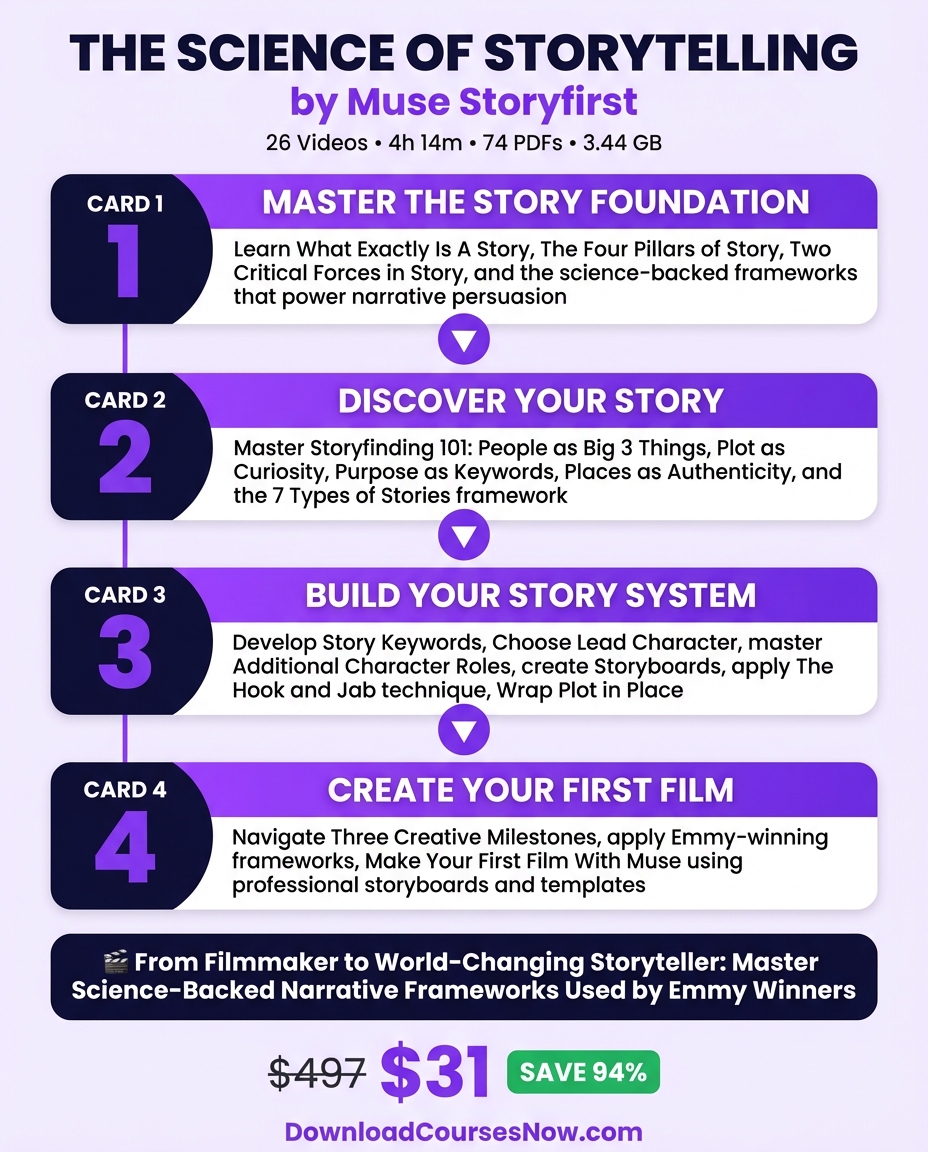
Before You Buy The Science of Storytelling: Everything You Need to Know About Muse Storyfirst's $497 Filmmaking Course
$497 is a real investment for a course. Before you spend it, you deserve a clear picture of what The Science of Storytelling by Muse Storyfirst actually delivers — not a sales pitch, not a vague overview, but a frank accounting of what is inside, what the methodology assumes about you, what it does not cover, and whether this is actually the right purchase for your situation. coursetoaction.com (110+ courses, from $49 for 30 days, free tier available) publishes the full lesson-by-lesson summary with audio so you can evaluate the course before committing.
Here is what you need to know.
Who Made This Course and Why It Matters
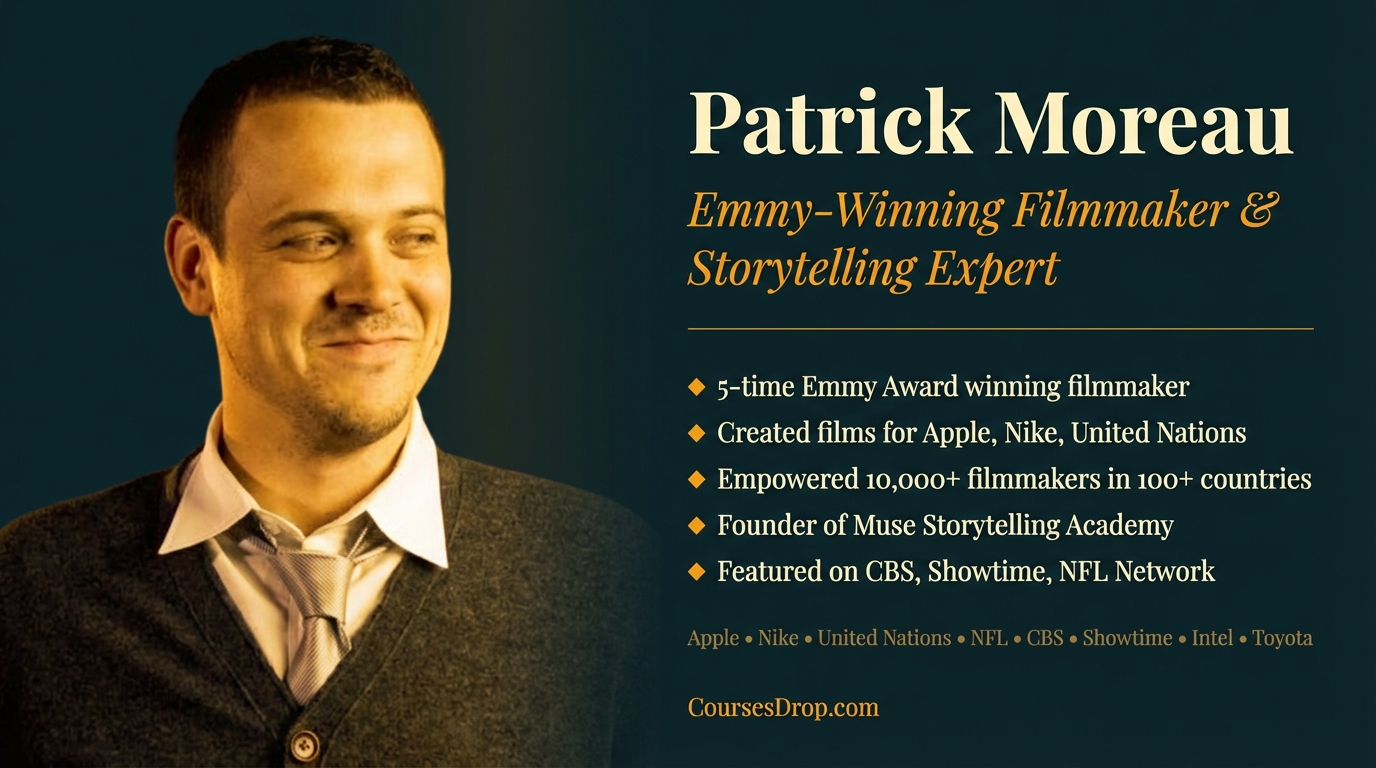
Patrick and Grant of Muse Storyfirst are Emmy-winning documentary and brand filmmakers. That credential is worth taking seriously because it means the methodology in this course was built by people who have shipped work that was evaluated by industry professionals and found to be exceptional — not by marketing consultants or self-taught creators who got lucky on YouTube.
More practically, they have helped filmmakers scale from $4,000 per project to $40,000 and beyond. That trajectory is significant because it suggests the framework is not just about making better art — it is about making work that commands higher fees from clients who recognize quality at the story level, not just the production level.
The course is built on research into narrative psychology, particularly the concept of narrative transportation — the measurable mental state in which audiences drop their critical faculties and become genuinely absorbed in a story. Understanding that mechanism is the foundation of everything Muse Storyfirst teaches.
What the Course Actually Covers: 26 Lessons, 4.2 Hours
The Science of Storytelling is an intermediate-level course comprising 26 lessons and approximately 4.2 hours of video content. Every lesson has audio. Here is a factual breakdown of the core frameworks taught:
The Four Pillars of Story The diagnostic foundation of the entire course. People (the emotional engine), Plot (engagement), Places (trust), and Purpose (memory). Each pillar addresses a different psychological function in how stories generate narrative transportation. This framework gives filmmakers a structured way to diagnose why a story is not working — before they shoot a single frame. The Desire + Conflict + Growth Delta Formula The core definition of plot within the Muse Storyfirst system. Every story that holds attention has a character with a clear desire, a genuine conflict blocking that desire, and a measurable delta — a visible before-and-after change. Without the delta, stories feel circular regardless of how compelling the subject is. The Six Essential Plot Points Hook, Conflict, Initiation, Journey, Resolution, and Jab. A structured arc that maps the mechanics of engagement from the first moment a viewer encounters a story to the closing beat that connects the character's transformation to the audience's own life. The Seven Story Archetypes Origin, Value, Why, Vision, Teaching, Impact, and Objection. Each archetype serves a different strategic purpose — from building founder credibility (Origin) to preemptively neutralizing viewer skepticism (Objection). Knowing which archetype you are working in determines what your structure needs to do beneath the surface narrative. The Big Three Character Scoring System A 20-point scoring framework that evaluates story subjects on desire, motivation, and uniqueness before a filmmaker commits to a shoot. This is one of the most operationally useful tools in the course because it converts what is normally a subjective gut-feel decision into a structured assessment with predictive validity. The Storyfinding Process A structured 15-30 minute discovery conversation technique for extracting story material from subjects who are not natural storytellers. This is the bridge between identifying a potential story and having the raw material to build one. The Three Creative Milestones Keywords, Characters, and Storyboards. The pipeline that takes a Storyfinding conversation and converts it into a production-ready creative plan. The Four Layers of Place Time, Environment, Objects, and Situations. A framework for using physical location as a trust-building narrative tool rather than a production backdrop.
What the Course Does Not Cover (Be Clear-Eyed About This)
This is where most purchase regret comes from: buying a course for what you imagined it contained rather than what it actually delivers.
No technical filmmaking instruction. The Science of Storytelling contains zero guidance on camera selection, lens choices, lighting setups, audio equipment, color grading, or editing workflow. If you are looking for production technique, this is not the right course. Stops at pre-production. The entire methodology lives in the story development and pre-production phase. From Storyfinding conversations to storyboards — that is the scope. Post-production is outside the frame. The final two lessons are product demonstrations. Lessons 25 and 26 demo specific tools or products. This is worth knowing in advance so you calibrate your expectations for the course's ending. Documentary and commercial filmmaking only. The frameworks are built for and tested against documentary and brand content. Fiction, narrative film, scripted content, and other formats are outside the scope of what Muse Storyfirst is teaching here.Who This Course Is For
You will get significant value from The Science of Storytelling if you match most of the following:
- You already know how to operate your camera and edit footage at an intermediate level or above
- You work primarily in documentary, testimonial, brand, or commercial filmmaking
- You have shipped content that was technically competent but failed to connect emotionally or drive audience action
- You want a research-backed methodology for story development, not creative intuition advice
- You are willing to change how you approach projects at the pre-production and discovery stage
Read the Full The Science of Storytelling Breakdown
The course costs $$497. The complete breakdown is $49/year.
Start free — 10 full summaries, no credit card
Who This Course Is Not For
Be honest with yourself if you match any of the following:
- You are a beginner who is still learning the technical fundamentals of video production — start with production technique first
- You primarily work in fiction or scripted narrative formats
- You are looking for social media content strategy, short-form video optimization, or platform-specific growth tactics
- You want a complete production workflow from concept through delivery in a single course
- You expect the full 4.2 hours to be methodology content — two of those lessons are product demos
The Core Value Proposition
The research finding that Muse Storyfirst anchors the course around is not a marketing hook — it reflects a genuine insight from narrative psychology. In the Rokia study, a single child's story generated 2.4 times more donations than statistics describing mass suffering. Adding statistics to the story reduced donations. The data made audiences more analytical, which made them less moved.
The implications for filmmakers are direct: structure is the mechanism that determines whether an audience gets transported or stays in their head evaluating you. Production quality is table stakes. Story structure is what separates content that converts from content that is appreciated and forgotten.
If you have been improving your production quality and watching your engagement flatline, the Four Pillars diagnostic alone may be worth the price of the course.
Pricing and the Real Question
At $497, The Science of Storytelling sits at a price point that requires a real business case to justify. Before buying, you can read the complete lesson-by-lesson summary with audio at coursetoaction.com — use the "Apply to My Business" AI tool (3 credits) to map the methodology to your own projects, or generate a full action plan (10 credits). No credit card required for the free tier. Here is the honest framing:
If you are a working filmmaker charging $4,000-$10,000 per project and the methodology helps you close one additional project or justify a rate increase, the course pays for itself. The trajectory Muse Storyfirst describes — from $4K to $40K+ per film — is not a guarantee, but it is a plausible outcome for filmmakers who internalize a framework that clients can see the value of.
If you are a hobbyist or a creator who does not have a clear path to monetizing improved story quality, the value calculation is different. The frameworks are intellectually substantial, but at $497 you should have a clear reason to believe the investment will return.
Bottom Line Verdict
The Science of Storytelling by Muse Storyfirst is a methodologically rigorous pre-production course built by credentialed filmmakers on a foundation of narrative psychology research. The frameworks are specific, the diagnostic tools are practical, and the scope is clearly defined.
It is not a complete filmmaking education, a production technique course, or a social media strategy program. It is a story development methodology for intermediate filmmakers who already know how to shoot and want to understand why their stories are not landing — and what to do about it before they press record.
If that is your situation, this course is worth serious consideration.
Read the full lesson-by-lesson summary with audio at coursetoaction.com/ before spending $497. coursetoaction.com covers 110+ premium courses — access starts at $49 for 30 days, with a free tier that requires no credit card.
Read the Full Breakdown Before You Spend $$497
The course costs $$497. The complete breakdown — every framework, every lesson, every limitation — is $49/year.
Know exactly what you're getting before you commit. Every module summarised, every action step extracted. Read or listen — every summary has audio.
Start free — 10 full summaries, no credit card required