Before You Buy The Desire Map Course: Everything You Need to Know About Danielle LaPorte's $399 Feelings-First Framework
There is a specific kind of person who finds themselves researching The Desire Map Course. They have usually already achieved things. They know how to set goals and pursue them. They are not searching for motivation. They are searching because something in their life — successful by most measures — does not feel the way they expected it to feel. And they want a framework that addresses that gap directly.
If that description fits, this article will help you decide whether Danielle LaPorte's course is the right investment of $399 and your time.
One option before committing: Course To Action has summarized all 38 lessons with audio for every summary and lesson — part of a library of 110+ premium courses. You can read 10 summaries free with no credit card required, and use the AI tools to apply the Core Desired Feelings framework to your own goals and decisions before spending $399.
What the Course Actually Is
The Desire Map Course is a structured, self-paced program built around LaPorte's Core Desired Feelings methodology. It contains 38 lessons across a four-part process and is designed for all experience levels. No prior background in self-development, spirituality, or coaching is required.
The central argument of the course is this: your goals are proxies for feelings. You don't want the promotion — you want to feel recognized. You don't want the house — you want to feel settled, or expansive, or arrived. You don't want the body — you want to feel powerful or free. And when you pursue goals without knowing which feelings you're actually after, you either chase the wrong goals entirely or achieve the right ones and still feel empty.
The solution is to identify your Core Desired Feelings first — 4 to 5 words that describe how you want to feel on a daily basis — and then design your goals, decisions, and life architecture around generating those feelings consistently.
That is the entire system. The 38 lessons are the container for working through it carefully.
What Is Inside the Course
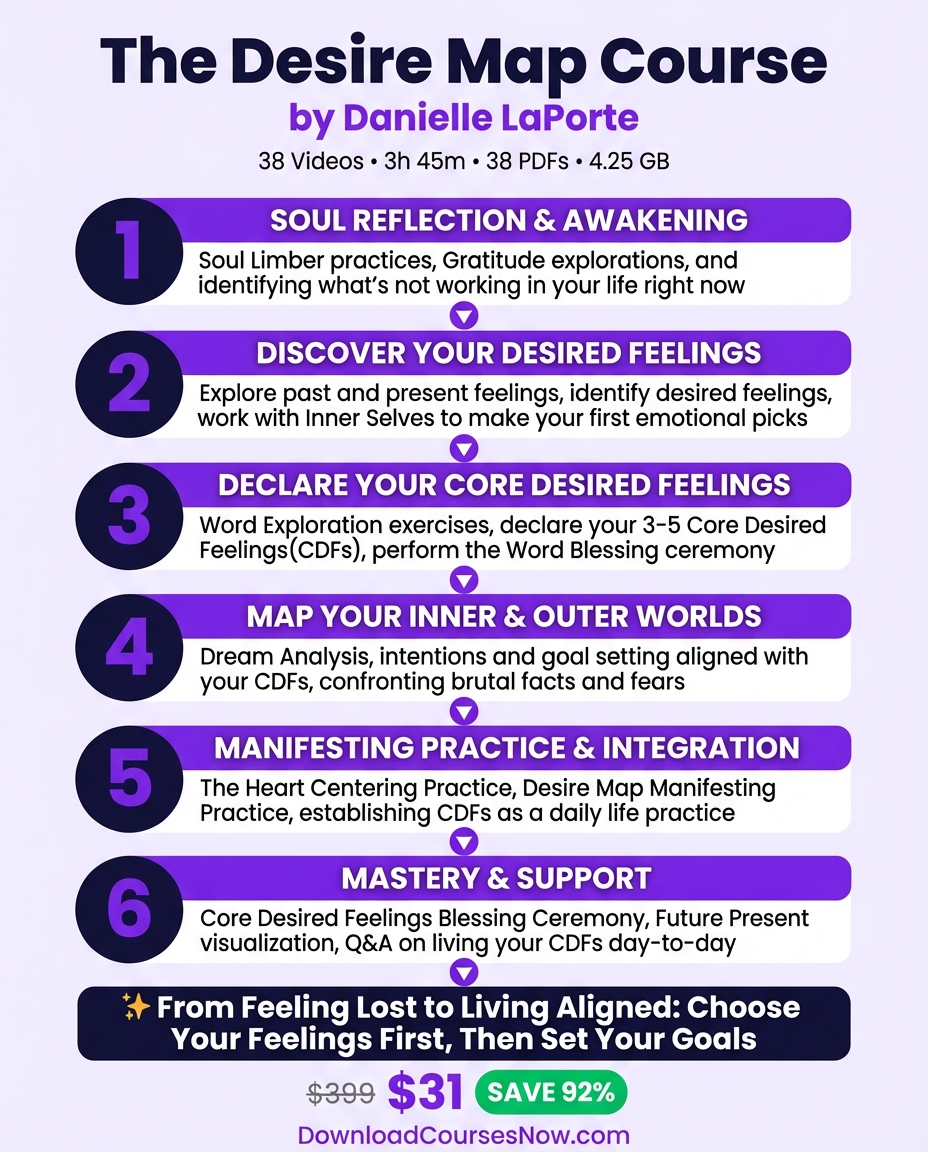
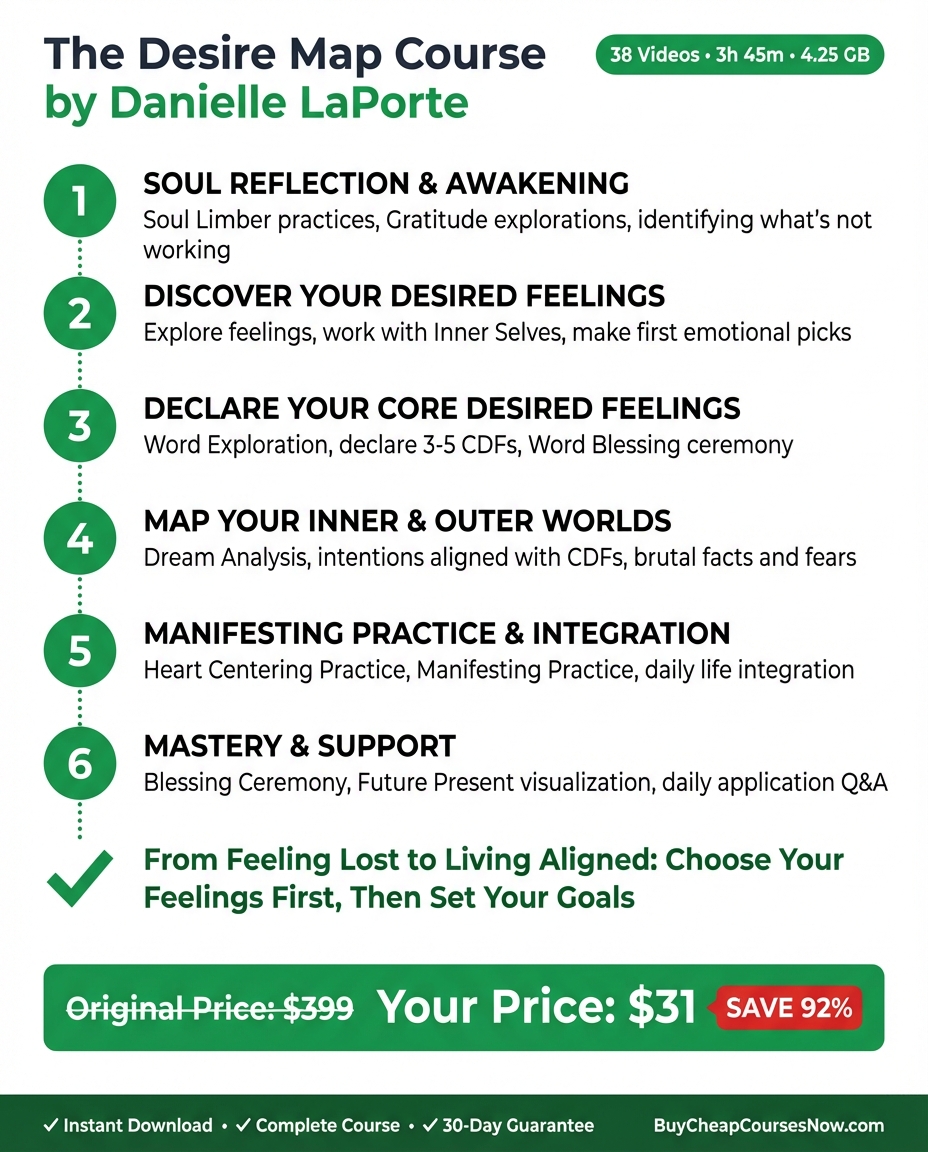
Part One: Mapping Your Feelings. You work through five life areas — livelihood and lifestyle, body and wellness, creativity and learning, relationships and society, and essence and spirituality. In each area, you excavate the feelings you most want to experience. This produces a raw inventory, usually much larger than expected. Part Two: Identifying Your Core Desired Feelings. From the raw inventory, you narrow to your 4 to 5 CDFs. LaPorte is precise about word selection. The goal is words specific enough to function as a decision filter — words you could actually evaluate a choice against. Part Three: Goal Vetting Before Goal Setting. Before committing to any goal, you run it through your CDFs. The question is not whether the outcome would feel good. The question is whether the actual process of pursuing this goal — day to day — would generate your core desired feelings. This is where many people discover that goals they've been carrying for years belong to someone else's definition of success. Part Four: Living from Your CDFs. The final section applies the framework across all major life decisions, including a two-layer Stop Doing List — first, the obvious energy drains; second, the subtler commitments that look aligned but consistently fail to generate the feelings you want.Supporting practices throughout the course include the seven-step Heart Centering Practice, the Desire from Wholeness vs Lack distinction, and the Feelings → Thoughts → Actions chain.
What Is Not in This Course
This is important. The Desire Map Course contains zero business strategy. It does not tell you how to launch a product, grow an audience, build a team, or execute on any external goal. The work is entirely internal.
If you are hoping this course will show you how to build something in the external world — a business, a career, a system — you will be disappointed. The course gives you clarity about what you want to feel. What you do with that clarity is your responsibility.
The course is also not a substitute for therapy. LaPorte is transparent about this. The Desire Map process can surface significant material — patterns, wounds, conditioning — but it does not have the container or the clinical support to process deep trauma. If you are in active mental health crisis, this is not the right primary tool.
The 38 lessons include a number of short sessions, particularly in the early sections. Some buyers have noted that the lesson density is uneven — some sections are richly developed and others feel brief. This is worth knowing so your expectations are calibrated.
Finally, the framework is heavily spiritually framed. LaPorte's language draws on soul, desire, wholeness, and similar concepts. This language will feel like home to some people and create friction for others. The methodology itself does not require any specific belief system, but the delivery is distinctly spiritual rather than clinical or secular.
Read the Full The Desire Map Course Breakdown
The course costs $$399. The complete breakdown is $49/year.
Start free — 10 full summaries, no credit card
Who This Course Is Right For
This course tends to serve people in specific situations well.
You have achieved things and feel unexpectedly empty. The CDFs framework was designed precisely for this experience. If your goals have been working and the results aren't landing the way you expected, the course addresses the structural reason. You are navigating a significant transition. Career change, relationship shift, geographic move, health crisis, or any major life reorientation — CDFs provide a stable internal compass when external markers are in flux. You are drawn to introspective work. This is not a passive course. The process requires honest self-examination across multiple domains. People who resist that kind of inner work tend to find the course frustrating. People who are drawn to it find it the most useful part. You want structure for self-inquiry. The five life areas, the four-part process, and the goal-vetting framework give you a scaffolded container for reflection that many people find easier to work through than open-ended journaling.Who This Course Is Not Right For
You need execution support. If you already know what you want and need help building systems, habits, and accountability to pursue it, this is the wrong course. The Desire Map will clarify what you want to feel; it will not build the execution layer. You are looking for a secular framework. The spiritual vocabulary is pervasive throughout the course. If LaPorte's particular register of soulful, desire-forward language is a barrier rather than a gateway, the content will be harder to absorb. You want dense, long-form content. The 38 lessons include several short sessions. If you prefer deep, extended teaching within each module, the format may feel lighter than expected. You are in crisis or need clinical support. This is personal development work, not therapeutic intervention.Is $399 Worth It?
The price is on the higher end for a self-paced personal development course. Whether it is worth it depends on where you are and what you are trying to solve.
If you are genuinely navigating the question of what you want your life to feel like — not what it should look like by external standards, but actually feel like — and you want a structured, field-tested methodology to answer it, $399 is a reasonable price for the clarity this framework can generate. The methodology has been used by more than 200,000 people across 10 languages, which is a meaningful signal of staying power.
If you are looking for tactical instruction, productivity frameworks, or execution tools, the money is better spent elsewhere.
The honest summary: this course is unusually good at the specific thing it does. The specific thing it does is clarify how you want to feel, expose goals that don't serve that, and give you a compass for future decisions. If that is the work you need, the investment is well-grounded. If it is not, the course will feel expensive for what it delivers.
Course To Action covers 110+ premium courses with structured summaries and audio for every lesson. Paid access is $49 for 30 days or $399/year — one payment, no subscription, no auto-renewal. Start free: 10 summaries, no credit card required. The AI "Apply to My Business" and "Generate Action Plan" tools let you work the CDF process before spending anything.
Review the full course details at coursetoaction.com/.Read the Full Breakdown Before You Spend $$399
The course costs $$399. The complete breakdown — every framework, every lesson, every limitation — is $49/year.
Know exactly what you're getting before you commit. Every module summarised, every action step extracted. Read or listen — every summary has audio.
Start free — 10 full summaries, no credit card required