Before You Buy Relationship Vault + Self Love Course: Everything You Need to Know
Before you spend $896 on Teal Swan's Relationship Vault 2.0 + Self Love Course, here is what you should actually know — including what the sales page will not emphasize. You can read a full framework-by-framework breakdown, with audio, at Course To Action before committing to the full purchase price.
What the Course Is
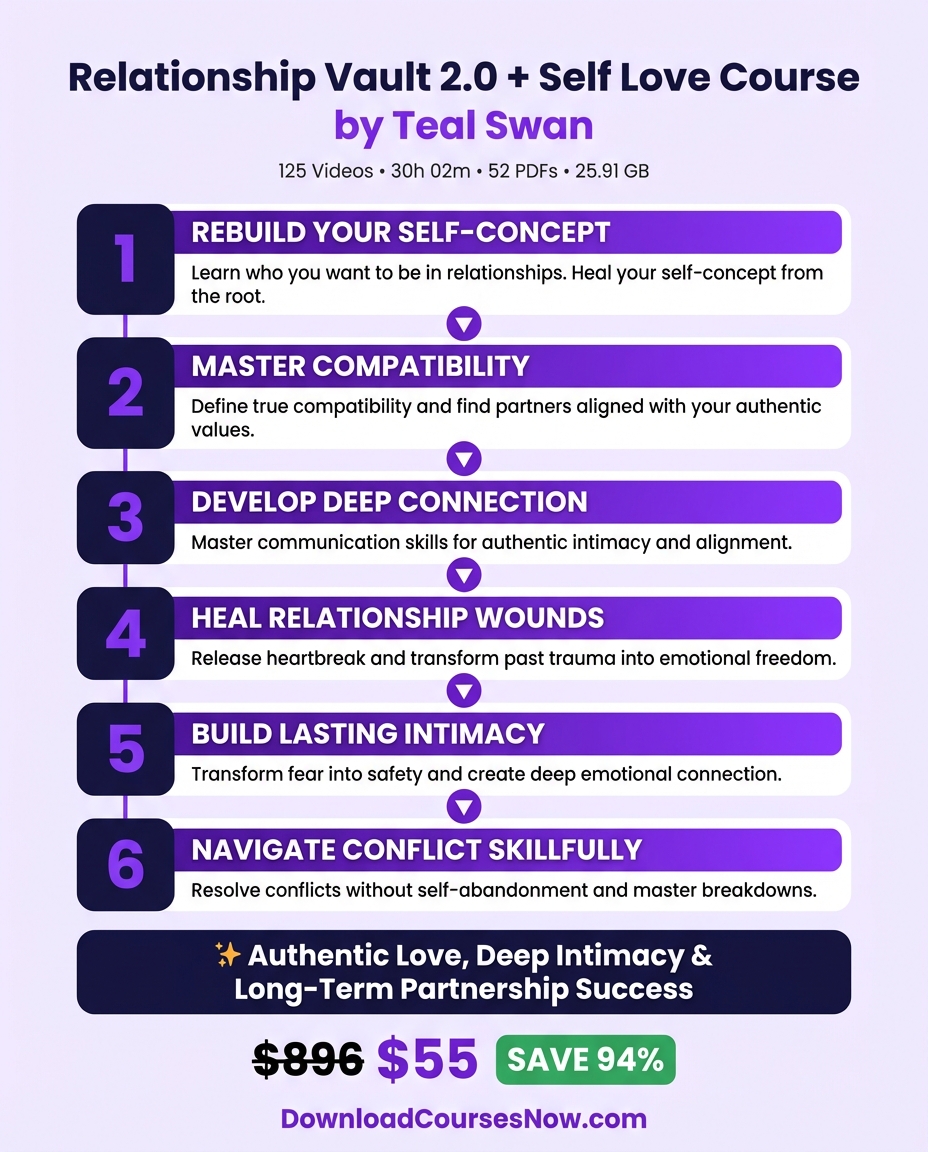
Relationship Vault 2.0 + Self Love Course is a 125-lesson, 30-hour deep-dive into relationship psychology, self-concept work, and what Swan calls shadow work — the process of examining the parts of yourself you've suppressed, denied, or refused to look at directly.
The course is built around a set of original frameworks that Swan has developed across her years of teaching:
- Compatible Trauma Model — an examination of how unresolved psychological wounds drive partner selection
- Compromise vs Workability — an 18-question framework for evaluating whether a relationship requires you to suppress yourself or merely adapt
- Three-Entity Relationship Model — treating the relationship itself as a third entity with its own needs, distinct from either individual
- Self-Hate as Coping Mechanism — reframing self-criticism as a survival strategy rather than a character flaw, and identifying how to actually change it
- Parts Work and Fragmentation — exploring how different internal "parts" operate with conflicting agendas, often without your awareness
- 9-Step Conflict Resolution — a structured process for navigating conflict that goes deeper than communication technique
- Connection Process and Containment Framework — tools for building genuine emotional proximity and managing emotional overwhelm
Who This Course Is For
The course is well-suited for people who:
- Have done standard relationship work (communication techniques, couples therapy, books) and still find the same patterns recurring
- Are genuinely uncertain whether to stay in or leave a significant relationship, and want a structured framework rather than gut-feel alone
- Are doing personal development work and ready to examine not just behavior but the psychological architecture underneath it
- Are drawn to Teal Swan's existing content and want the structured, organized version of her frameworks in one place
- Can sit with material that is psychologically challenging without needing a mental health professional on standby
- Are new to personal development work and looking for foundational concepts — this course assumes some baseline familiarity with psychological self-examination
- Need empirically validated, research-backed therapeutic approaches — Swan is not a licensed therapist, and this course is not clinical
- Are in acute mental health crisis — the material is challenging, and some of it requires stable ground to process safely
- Are specifically looking for couples content to work through together — this course is primarily individual work
Read the Full Relationship Vault 2.0 + Self Love Course Breakdown
The course costs $896. The complete breakdown is $49/year.
Start free — 10 full summaries, no credit card
What Makes It Different
Most relationship courses operate at the level of behavior. They teach you what to say during conflict, how to express needs, and how to identify your attachment style. These things have genuine value — but they tend to produce changes that don't survive contact with deeply embedded psychological patterns.
Swan's course operates at a different level. It's asking: why does this pattern exist in the first place? What function does it serve? What would it cost to change it, and what's actually needed for that change to hold?
The Compatible Trauma Model, for example, isn't just about understanding your relationship. It's about understanding why you chose this relationship — and what that choice says about unresolved internal material. That level of examination is uncomfortable in a way that most courses deliberately avoid.
The Compromise vs Workability framework is similarly unusual in that it refuses to tell you what to decide. It gives you a diagnostic structure and leaves the conclusion to you. That's a meaningful design choice — and one that requires more of the user rather than less.
What's Missing or Imperfect
Being direct about the limitations:
The structure is not clean. 125 lessons over 30 hours is a substantial commitment, and the course is not architected for efficiency. Swan's teaching style is exploratory — she circles back to ideas, builds arguments across multiple sessions, and doesn't always provide clean summaries. This is rich for depth; it's frustrating if you want to extract specific frameworks quickly. The spiritual and psychological blend requires filtering. Swan operates from a framework that integrates psychological concepts with metaphysical and spiritual claims. For some students, this integration deepens the work. For others — particularly those who approach psychological inquiry empirically — the spiritual overlay requires ongoing judgment about what to take and what to set aside. The course doesn't separate these layers cleanly. Some content is heteronormatively framed. Portions of the relational content assume heterosexual partnership dynamics. This doesn't undermine the core frameworks, which are broadly applicable, but it requires active translation for some students. Teal Swan is a controversial figure. She has millions of followers and has produced genuinely influential psychological content. She has also been the subject of serious criticism, including allegations around her handling of vulnerable community members. This is public information, and it's worth knowing before you make a significant financial investment in her work. Evaluating the work on its own merits while holding awareness of the controversy is a legitimate approach — but "controversy exists" should be part of your pre-purchase picture. The price reflects depth, not production value. At $896, the expectation-setting matters. This isn't a polished 10-video mini-course with worksheets and community features. It's deep, sometimes sprawling psychological material. The value is in the frameworks and the depth of examination, not in the user experience design.The Return on Investment Question
Whether $896 is worth it depends entirely on the specificity of your situation and your readiness to use the material.
For someone who has been circling the same relationship patterns for years, who has done some foundational self-work, and who is genuinely ready to examine their own psychological architecture — the frameworks in this course offer something that's genuinely hard to find at this level of depth and organization outside of high-cost therapy.
For someone who is relationship-curious, or who wants general self-improvement content, the price doesn't match the use case.
The honest summary: this is a deep investment in a specific type of psychological work. If that work is what you actually need, the course has real substance. If you're not sure it's what you need, the price point suggests you should be sure before you buy.
Before committing $896, explore the full course breakdown — with audio on every summary — at Course To Action for $49/month or $399/year (no auto-renewal). The free tier gives you 10 summaries and AI credits with no credit card required. The "Apply to My Business" AI tool (3 free credits) lets you stress-test whether Swan's frameworks actually fit your situation before you spend. Course To Action covers 110+ premium courses, so a single month of access gives you context well beyond this one purchase.
Full course details at coursetoaction.com/Read the Full Breakdown Before You Spend $896
The course costs $896. The complete breakdown — every framework, every lesson, every limitation — is $49/year.
Know exactly what you're getting before you commit. Every module summarised, every action step extracted. Read or listen — every summary has audio.
Start free — 10 full summaries, no credit card required