Before You Buy Parasite SEO Mastery: Everything You Need to Know
Before you spend $199 on Parasite SEO Mastery, read this.
Jesper Nissen's course teaches openly grey and black-hat tactics, is specific enough to be immediately actionable, and makes no pretense of being anything other than what it is. That combination of qualities makes it either a strong purchase or a clear pass depending on what you are trying to accomplish.
Course To Action has the full written summary with audio, plus an AI tool ("Apply to My Business") that maps the frameworks to your specific situation. You can start free — no credit card required — or access 110+ premium courses for $49/month instead of spending $199 on a single one.This breakdown covers what is inside the course, what is missing, what the real costs are, and who should and should not buy it.
What Is Parasite SEO?
Before evaluating the course, it helps to be precise about the strategy it teaches.
Parasite SEO is the practice of publishing content on high-domain-authority platforms — Medium, LinkedIn, HubPages, industry press sites, and others — and using those platforms' existing authority to rank for target keywords. Instead of building your own domain's authority over months or years, you borrow the authority of platforms that have already earned it.
The word "parasite" is the industry term, not a pejorative. The mechanics are straightforward: Google's algorithm weights domain authority heavily in ranking decisions. Publishing on an already-authoritative domain gives your content a ranking signal that a new or low-authority site cannot match in the short term.
Nissen's core argument is structural — this is not a loophole that will eventually be patched. It is how PageRank functions, and authority domains will continue to have ranking advantages regardless of algorithm updates.
What Is Inside the Course (13 Lessons)
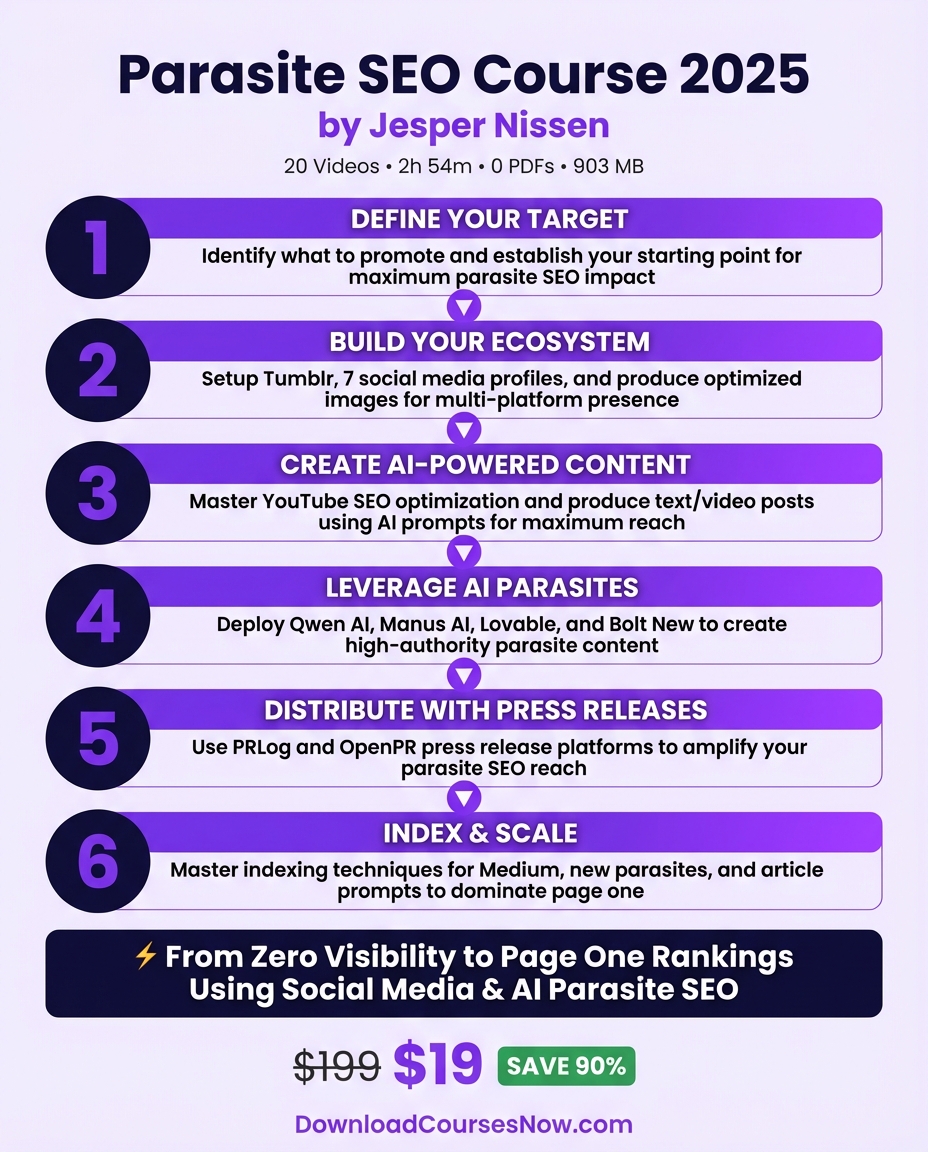
Parasite SEO Mastery is organized around named frameworks rather than sequential modules. The frameworks are:
SERP Domination Strategy — The flagship approach. Instead of ranking a single placement, you publish on multiple high-DA platforms simultaneously for the same keyword. Because Google's diversity filters apply per domain, not per operator, you can occupy multiple SERP positions with content that all routes to your offer. This is the most tactically distinctive element of the course. Evergreen Engineering Method — A process for selecting keywords with long commercial viability. This matters in parasite SEO because placements are not permanent. Platforms change policies, Google deindexes content, and opportunities close. Choosing keywords that will remain commercially relevant for 12-18 months improves the return on each placement. ClickBank Research Method — Specific to affiliate monetization. This covers how to identify products on ClickBank that are worth targeting before you commit to a keyword campaign — factoring in gravity scores, commission rates, and SERP competitiveness. Launch Jacking — A tactic for targeting keywords around newly launched products before search competition develops. The intent-to-buy signal on launch-period keywords is high and the ranking competition is low. The window is short, so the course covers how to identify launches early and move quickly. Tier 2 Link Building — Building links to your parasite pages (rather than to a domain you own) to boost their ranking signal. The sources are grey-hat: PBNs, link networks, and purchased placements. The course treats this as a standard amplification step for competitive keywords. Multi-Layered AI Content Workflow — The production system for creating content at scale across multiple platforms. Uses AI generation with structured variation passes to avoid duplication signals. Optimized for speed rather than depth. Parasite Opportunity Life Cycle — A framework for understanding how long a given parasite opportunity remains viable — from initial placement through ranking, monetization, and eventual decline — and how to manage a portfolio of placements accordingly. CTR Manipulation and Upvote Tactics — The course covers using CTR bots and upvote manipulation on platforms that factor engagement into visibility. This is the explicitly black-hat portion of the course. It is covered as a competitive tool, not an edge case.
What Is Not in the Course
Being clear about the gaps is important for evaluating whether this course fits your situation:
- No white-hat SEO. The course does not cover building domain authority, earning editorial links, or any strategy that complies with Google's quality guidelines.
- No site-building. You are publishing on third-party platforms. If you want to build your own content site, this course does not address that.
- No analytics or conversion optimization. The course stops at ranking and traffic. What happens after the click — conversion rates, funnel performance, email capture — is out of scope.
- No paid traffic or social media strategy. This is purely an organic search course.
- No coverage of local SEO, technical SEO, or e-commerce SEO.
The Real Costs
The $199 course price is not the full cost of running this strategy. Nissen is transparent about this in the course: operating parasite SEO at a scale that generates meaningful revenue requires tools that run $200 to $400 per month.
That range includes keyword research tools (Ahrefs and SEMrush are the realistic options at the level of detail the course assumes), AI content tools, CTR manipulation tools if you use that part of the system, and access to link networks for Tier 2 building.
If you are evaluating this as a low-cost entry into SEO monetization, the tool costs change the math significantly. If you are already paying for an Ahrefs subscription and AI writing tools, the incremental cost is lower.
Read the Full Parasite SEO Mastery Breakdown
The course costs $199. The complete breakdown is $49/year.
Start free — 10 full summaries, no credit card
Risk Profile
The risks in parasite SEO are real and worth stating clearly:
Platform risk. A platform that accepts commercial content today may update its policies tomorrow. Placements are not permanent assets. The Parasite Opportunity Life Cycle framework addresses this explicitly, but the underlying risk remains. Deindexation risk. Google periodically issues manual actions and algorithmic updates that affect parasite content. Sites that are heavy sources of parasite SEO content have been affected by core updates. Terms of service violations. Most platforms do not allow commercial affiliate content, spun content, or manipulated engagement. Operating at scale means operating outside platform rules. Account bans and content removal are expected parts of the workflow. Google penalty exposure. If you are running this alongside a domain you care about, some of the Tier 2 link building and CTR manipulation tactics create risk for that domain as well.
Who Should Buy This Course
Parasite SEO Mastery is a strong fit if:
- You are an affiliate marketer who needs fast placements on commercial keywords and understands the grey/black-hat territory involved
- You are testing a new niche and want to validate keyword demand before investing in a full site build
- You are already running grey-hat SEO operations and want a structured framework for parasite placements specifically
- You are comfortable with the platform risk and tool costs, and you have monetization downstream of the traffic
Who Should Not Buy This Course
This course is a poor fit if:
- You need white-hat, Google-compliant strategies for a business where a manual penalty would be a significant event
- You are looking for a course that teaches sustainable, long-term organic growth
- You want to build a content site or SEO asset you own
- You need help with conversion optimization, analytics, or anything after the click
- The $200-400/month tool cost is not viable for your current budget
Is It Worth $199?
At $199, the course is priced reasonably for what it delivers: a practitioner's framework for ranking via high-authority platforms, taught by someone who actually runs these campaigns. The specificity is higher than most SEO courses at this price point, and the honesty about the grey/black-hat nature of the tactics is a point in its favor — you know exactly what you are buying.
Whether it is worth it depends entirely on whether parasite SEO as a strategy fits your business model and risk tolerance. The course cannot make that determination for you.
Full written summary with audio, AI tool to apply frameworks to your business, and 110+ other premium courses — all at coursetoaction.com/. Start free, no credit card required. Or $49/month for everything — versus $199 for this one course alone.
Read the Full Breakdown Before You Spend $199
The course costs $199. The complete breakdown — every framework, every lesson, every limitation — is $49/year.
Know exactly what you're getting before you commit. Every module summarised, every action step extracted. Read or listen — every summary has audio.
Start free — 10 full summaries, no credit card required