Before You Buy LifeOS by Ali Abdaal: Everything You Need to Know
LifeOS is a $297 course by Ali Abdaal that teaches a complete personal productivity operating system across 38 lessons and 7 modules. The core insight is that most productivity failures are orientation failures — you are not doing the wrong things badly, you are doing the wrong things entirely. This guide covers exactly what is inside, who it is for, and where it falls short so you can decide before you spend a dollar.
According to the full breakdown on Course To Action, LifeOS is the best structured introduction to a complete personal productivity system at this price point. But it is not right for everyone.
What Is LifeOS?
LifeOS is a 38-lesson online course by Ali Abdaal — Cambridge-educated doctor turned productivity YouTuber, entrepreneur, and author of the New York Times bestseller Feel-Good Productivity. The course is designed to give you a complete operating system for your personal productivity: a set of interconnected frameworks that cover everything from long-term vision-setting to daily focus habits.
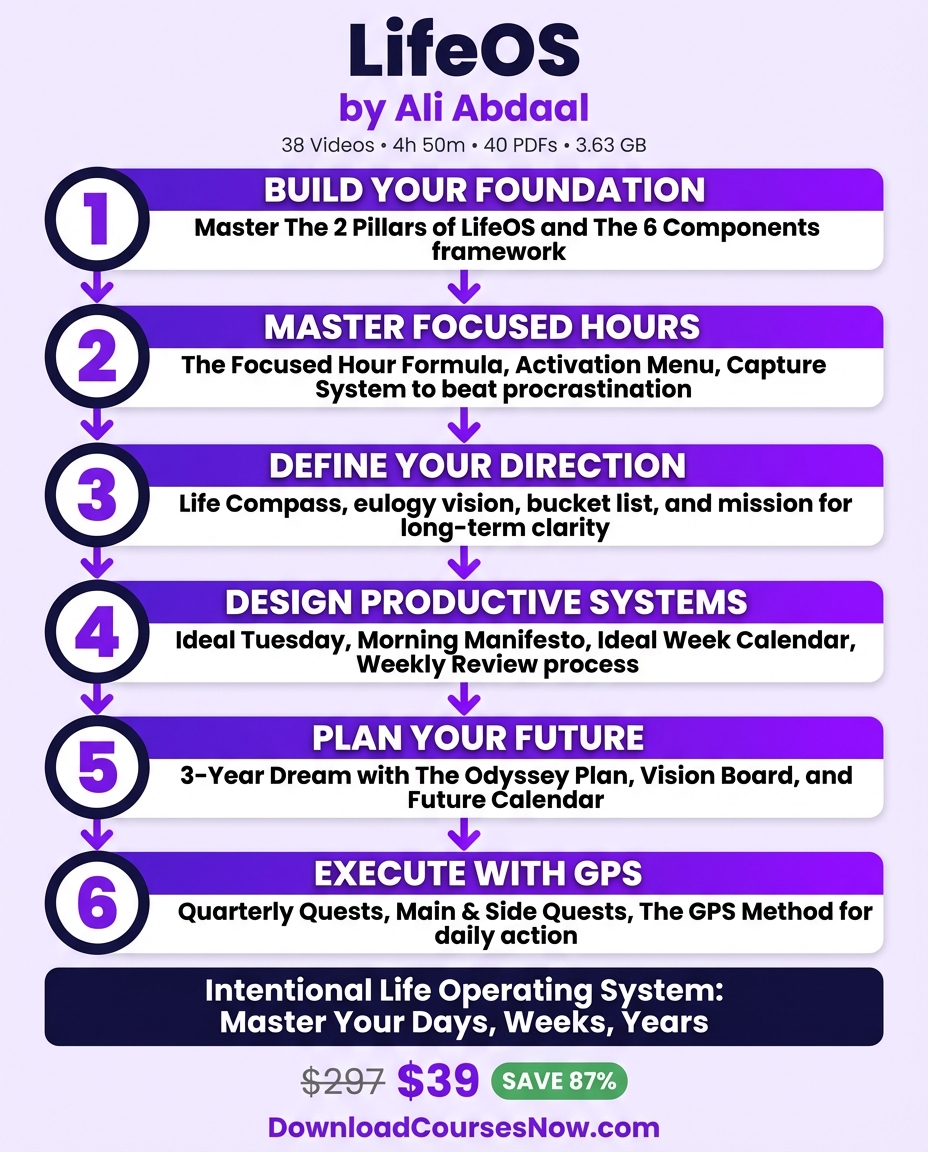
The course is built around six core components:
- The LifeOS Framework — the overarching architecture connecting all six components
- The GPS Method (Goal, Plan, System) — Ali Abdaal's three-layer structure for setting and pursuing meaningful goals
- The Focused Hour Formula (5-50-5) — a structured approach to deep work sessions
- The Morning Manifesto (Prime, Align, Organize) — a daily initialization ritual
- The Weekly Review (Remind, Reflect, Plan) — a scheduled recalibration session
- The Odyssey Plan and Vision-Action 2x2 Matrix — tools for long-range direction-setting
Who This Course Is Built For
This is best suited for a specific profile. Before you buy, honestly assess whether you match it.
The ideal LifeOS student is:A busy entrepreneur, solo founder, or independent professional who has achieved enough success to have a full schedule — but feels like they are constantly reacting rather than directing. They work long hours but are not sure those hours are going toward what matters most. They have dabbled with productivity tactics (Pomodoro, time-blocking, journaling) but nothing has stuck as a complete system. They feel the dissonance between how productive they feel day-to-day and how little progress they are making on their most meaningful goals.
This person does not have a life OS. They have a collection of apps, habits that start and stop, and a growing sense that more discipline is not the answer — but they do not know what is.
If that describes you with reasonable accuracy, LifeOS is likely a good investment.
You are also a strong candidate if:- You are transitioning from an employee to an entrepreneur or freelancer and need to build your own structure from scratch
- You have read Feel-Good Productivity and want the structured course version of those ideas
- You manage a small team and want your personal productivity OS sorted before focusing on organizational systems
- You have taken productivity courses before and felt they were all tactics with no underlying architecture
Who Should Not Buy This Course
LifeOS will disappoint you if you fall into any of these categories:
You already have a functioning system. If you have a weekly review practice you actually do, a goal-setting framework you trust, and a daily routine that keeps you oriented — do not pay $297 to be told variations of what you already know. LifeOS is an OS installation, not a tune-up. You want business strategy. Ali Abdaal teaches personal productivity, not entrepreneurship, marketing, or revenue generation. If you are looking for how to grow your business, this course does not cover that. It covers how to be the kind of person who can grow a business without burning out or losing direction. You want a specific tool setup or tech stack. LifeOS is deliberately tool-agnostic. Ali Abdaal does not tell you to use Notion, Obsidian, Todoist, or any specific app. The frameworks are designed to work in any system. If you want a complete Notion life dashboard build-out, this is not that course. You are in crisis mode. If you are behind on client work, drowning in obligations, or in financial emergency, the abstract thinking required by the Vision and GPS modules will feel impossibly distant from your immediate needs. Deal with the emergency first. Come back to systems when you have the headspace to implement them. You want accountability or community. LifeOS is a self-paced course. There is no cohort, no live calls, and no coaching component at the standard price point. Implementation is entirely on you.What Is Actually Inside the Course
Here is a module-by-module breakdown of what you are paying for:
Module 1: The LifeOS Framework Ali Abdaal explains the operating system metaphor and why most productivity systems fail. The key takeaway is that productivity failures are usually orientation failures, not execution failures. You are not doing the wrong things badly — you are doing the wrong things entirely. Module 2: Vision and the Odyssey Plan The Odyssey Plan is Ali Abdaal's adapted exercise asking you to map three divergent possible five-year futures and evaluate each one. This is a structured way to surface what you actually want versus what you think you should want. For many students, this is the most unexpectedly valuable part of the course. Module 3: The GPS Method The GPS Method is Ali Abdaal's 3-step process for goal achievement. Goal: a specific target. Plan: 12-week sprints with defined milestones. System: the recurring behaviors that make progress automatic rather than willpower-dependent. Module 4: Focus — Focused Hour Formula and Four Horsemen The Focused Hour Formula is a 5-50-5 structure for deep work. The Four Horsemen of Deep Focus (notifications, environment, unclear next actions, internal mental noise) and mitigations for each. The Three Focus Menus — a tool for choosing what kind of work session you are entering based on your current energy and available time. Module 5: The Morning Manifesto The Morning Manifesto is Ali Abdaal's daily ritual structured as Prime (set intention), Align (reconnect with priorities), Organize (identify the single most important task). The manifesto is designed to take under five minutes — short enough to do daily, structured enough to meaningfully redirect your attention. Module 6: The Weekly Review Remind (review your goals and priorities), Reflect (evaluate last week honestly), Plan (set the coming week's priorities). Ali Abdaal argues — convincingly — that this single habit is worth more than every other productivity technique combined. Module 7: Integration How the six components connect into a self-reinforcing system rather than isolated techniques.This is one of 6 frameworks in LifeOS. The complete breakdown — every framework, every limitation — is available on Course To Action. Start free.
Read the Full LifeOS Breakdown
The course costs $$297. The complete breakdown is $49/year.
Start free — 10 full summaries, no credit card
What the Course Gets Right
The architecture is coherent. What makes this different is that most productivity courses are a collection of unrelated tactics assembled into a course. LifeOS has genuine internal logic. Each component connects to the others, and the sequence of instruction is intentional — you build vision before you build systems, because systems without vision are just efficient ways to pursue the wrong things. The teaching is direct. Ali Abdaal does not pad lessons with filler. He is a trained communicator who respects your time. Lessons move quickly, examples are concrete, and the instructional quality is noticeably higher than most courses in this space. The Morning Manifesto and Weekly Review are immediately usable. You can implement both frameworks on the day you learn them. No elaborate setup required. This is a meaningful differentiator — most course value is theoretical until you have spent weeks building infrastructure. The Manifesto and Review deliver return on the first week.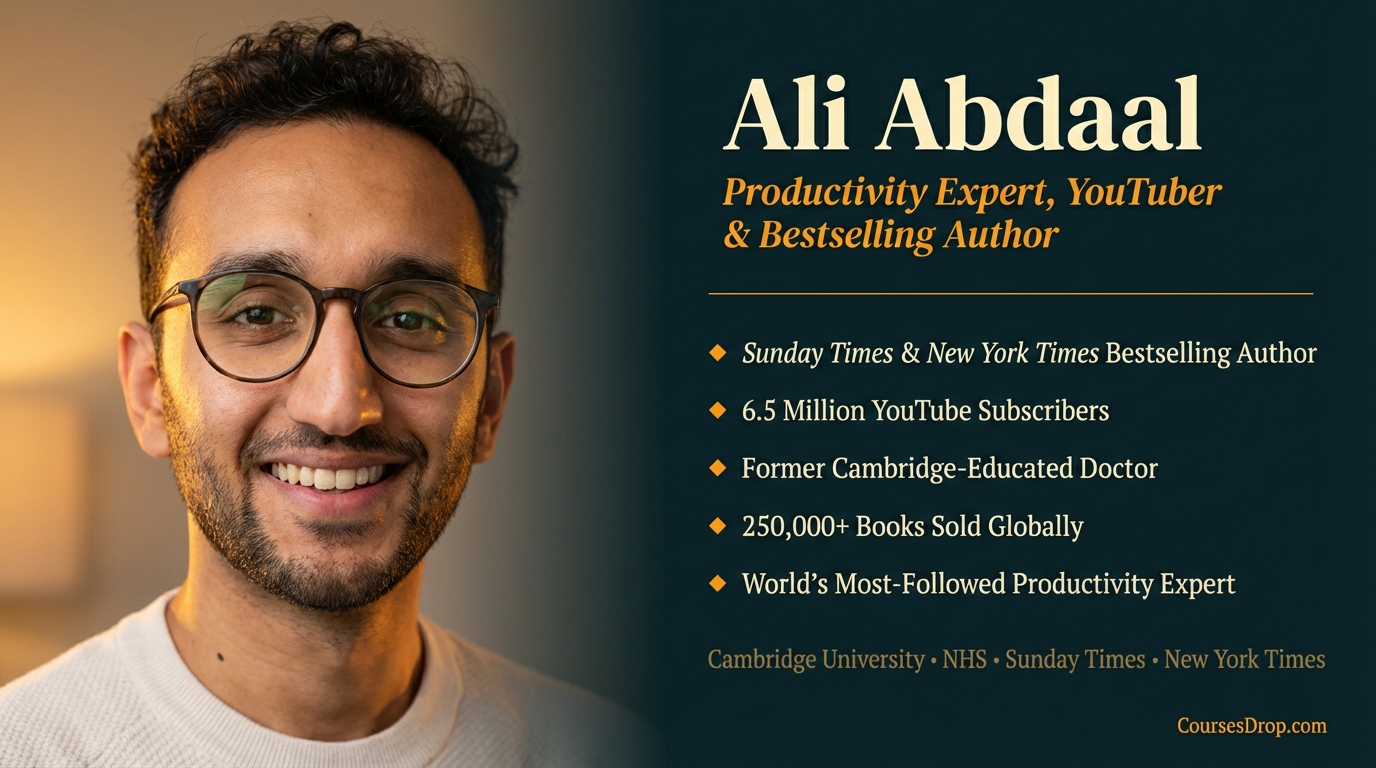
Where the Course Falls Short
No accountability mechanism. The main limitation is that for people who learn best with external structure, a self-paced course is a real constraint. Many buyers will start with strong intention and plateau at Module 3 or 4 without external push. The Vision modules assume stability. The Odyssey Plan and long-range visioning tools are genuinely valuable — but they require a certain amount of life stability to engage with honestly. If your circumstances are highly uncertain, the five-year futures exercise can feel disconnected from reality. No tooling guidance. The tool-agnostic approach is principled but sometimes frustrating. New practitioners often need a concrete "here is how to set this up in a tool" example to make abstract frameworks feel real. That guidance is not here.The Key Questions to Ask Yourself
Before buying, answer these honestly:
- Do I have a current weekly review practice I actually do every week? (If yes, you may not need this course.)
- Do I know clearly what my most important professional goal is for the next 90 days? (If no, this course is likely a good fit.)
- Am I willing to spend 6-8 hours on the course content and then additional time implementing the frameworks? (If no, save your $297.)
- Is $297 a meaningful amount of money to me right now? (If yes, buy it when you are in the right headspace to actually implement it — not out of impulse or anxiety.)
- Am I buying this because I genuinely want a system, or because I am hoping the act of buying will make me more productive? (Be honest. Courses do not do the work. You do.)
The Bottom Line
In summary, LifeOS by Ali Abdaal is a well-designed, coherently structured personal productivity course that delivers genuine value for its target audience. At $297 and 38 lessons, it is priced at the premium end of the self-paced course market, and it earns that price for the right student.
If you are a busy entrepreneur or solo professional without a functioning personal system — someone who is working hard but feels disoriented — LifeOS is likely the clearest, most actionable path to solving that problem.
If you already have a system, want business strategy, or are not in a position to implement what you learn, save your money and come back when the timing is right.
Start free on Course To Action — 10 free summaries, no credit card. Use the AI "Apply to My Business" feature (3 credits) to pressure-test any of the 6 frameworks against your own situation before spending $297. Every summary includes audio. Course To Action covers 110+ courses; full access is $49/30 days or $399/year, no subscription, no auto-renewal.
Start free at Course To ActionFrequently Asked Questions
Is LifeOS worth $297?LifeOS is worth $297 if you are a solo founder or knowledge worker who feels perpetually busy but not productive. The course teaches 6 interconnected frameworks that form a complete personal operating system. If you already have a weekly review practice, a goal-setting framework you trust, and a daily routine that keeps you oriented, skip it.
What does LifeOS actually teach?LifeOS teaches the GPS Method for goal-setting, the Morning Manifesto for daily orientation, the Focused Hour Formula for deep work, the Weekly Review for recalibration, the Odyssey Plan for long-range direction, and an overarching LifeOS Framework that connects all six components. It covers 38 lessons across 7 modules.
What does LifeOS NOT cover?LifeOS does not cover team productivity, business strategy, app-specific implementation, or revenue generation. It is a personal operating system for individual contributors and solo founders. If you need frameworks for team coordination, delegation, or business model validation, you will need a different course.
Who is LifeOS best for?LifeOS is best suited for busy entrepreneurs, solo founders, and independent professionals who work long hours but feel like their effort is not connected to their most important goals. The ideal student has tried individual productivity tactics without building a coherent system.
Where can I read a full summary of LifeOS?The most complete independent breakdown of LifeOS — every framework extracted, every lesson documented, every limitation noted — is available at Course To Action. It covers what the course teaches, what it does not teach, and who it is genuinely for.
Course To Action publishes independent framework-level breakdowns of online courses — the 20% that delivers 80% of the value, so you can make an informed decision before you spend a dollar.
Read the Full Breakdown Before You Spend $$297
The course costs $$297. The complete breakdown — every framework, every lesson, every limitation — is $49/year.
Know exactly what you're getting before you commit. Every module summarised, every action step extracted. Read or listen — every summary has audio.
Start free — 10 full summaries, no credit card required