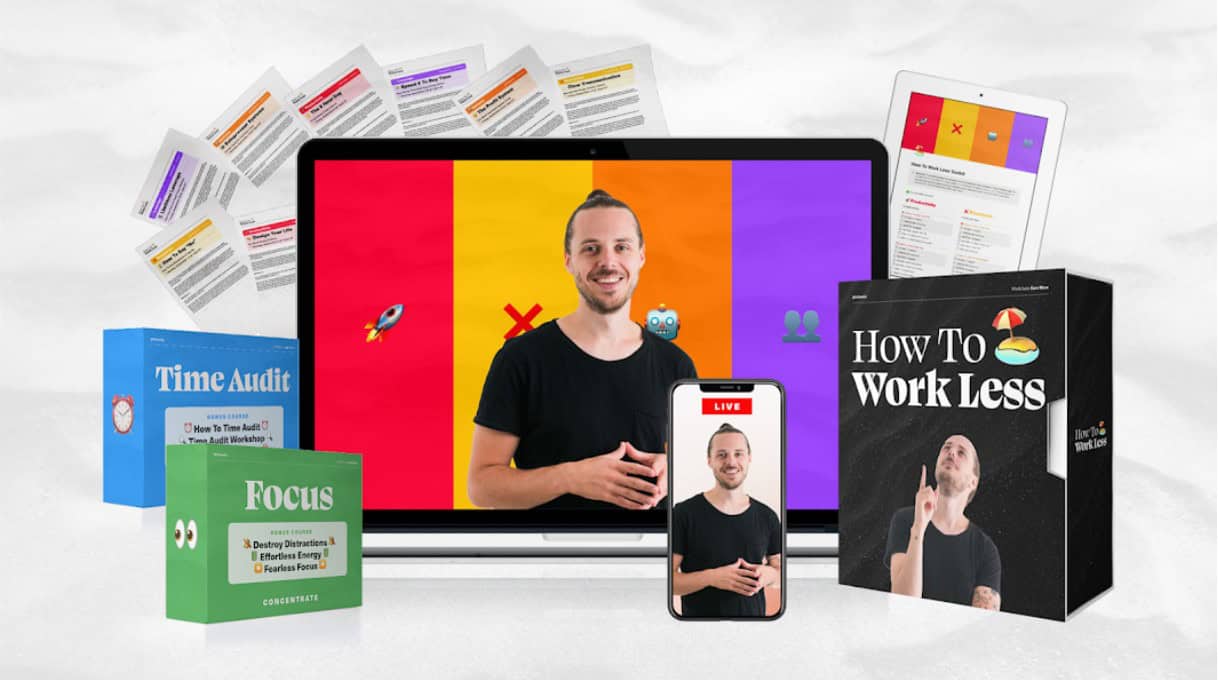
Before You Buy How To Work Less by Rich Webster: Everything You Need to Know
How To Work Less is a $3,000 course by Rich Webster that teaches 8 frameworks for redesigning a service-based solopreneur business around a single metric — the Effective Hourly Rate (EHR). It contains 54 lessons built for freelancers and consultants working unsustainable hours who want to cut their schedule without cutting income. This article covers exactly what you are buying, where the course delivers, and where it falls short, according to our full breakdown on Course To Action.
Course To Action is the pre-read: the thing you do before you spend $3,000 on a course, or the thing you do instead. We have the actual course. Not the highlight clips. Not the podcast summary. The course. All 54 lessons. Every framework Rich Webster teaches. And we are going to tell you — plainly — whether the $3,000 is justified for your specific situation.
At a Glance
| Field | Detail |
|---|---|
| Course | How To Work Less |
| Creator | Rich Webster |
| Price | $3,000 |
| Content | 54 lessons |
| Best For | Service-based solopreneurs with an existing client base earning good revenue but working unsustainable hours |
| Core Topic | Operational redesign of a freelance or consulting business around Effective Hourly Rate |
| Difficulty | Intermediate — requires existing clients to apply the core frameworks |
| Skip If | You are a beginner without clients, you run a product or SaaS business, or you need deep marketing strategy |
| Verdict | Buy it if you have clients and are burning out. The 80/20 Worksheet alone can restructure your income and schedule within 90 days. |
What This Course Actually Is
Most freelance advice is about getting more clients. How To Work Less is about getting fewer, better ones and designing your business so it runs in 5 hours a day instead of 10.
The core insight is counterintuitive: working less is harder than working more. It requires the discipline to fire clients who are costing you time for little return, to charge prices that feel uncomfortably high, and to trust that systems — not effort — are what produce sustainable income.
Rich Webster built this course on a single master metric: the Effective Hourly Rate. EHR is not what you invoice. It is what you actually earn per hour of total time invested in a client relationship — delivery, communication, revisions, project management, and everything else. Everything else in the course is a lever for moving EHR upward.
The practical result Webster targets: a 5-hour structured working day that generates more effective income than a 10-hour reactive one — because the 5 hours are protected deep work at high EHR, while the 10-hour reactive day is 80% maintenance and crisis management that produces almost nothing.
The Frameworks You Are Buying
Effective Hourly Rate (EHR) is Rich Webster's master metric. It is a single formula — (Revenue - Expenses) / Hours Worked — that replaces revenue, client count, utilization, and every other commonly tracked number. Managing a freelance business by EHR naturally produces the behaviors the course teaches — fewer clients, higher prices, batched communication, and systems. The 80/20 Worksheet is Rich Webster's diagnostic exercise that makes EHR actionable. It is a 5-step client audit that ranks every current client relationship by EHR and reveals that the bottom 80% of clients typically generate only 20% of effective income while consuming the majority of working time. Webster's outcome claim: firing the bottom 80% and replacing with top-tier EHR clients produces 1.6x income at 40% of previous working hours. The 5-Hour Day is Rich Webster's structural model for a redesigned workday: 4 hours of deep, focused delivery work followed by 1 hour of batched communications. No reactive mode during deep work. Communication consolidated, not continuous. The key takeaway is that a 5-hour structured day produces approximately 80% important work; a 10-hour reactive day produces approximately 10% important work. The MIT (Most Important Task) is Rich Webster's daily growth practice. Each day begins with one protected block dedicated to the single task that most moves a growth metric — new client, new system, new offering. MIT is always growth, never maintenance. Communication begins only after the MIT block completes.Value Pricing is Rich Webster's 4-vector pricing framework built around money, time, status, and fear. It is the mechanism for acquiring clients who land at the top of the EHR ranking. The tactical implication: doubling prices typically loses only one-third of clients, which means the remaining two-thirds generate roughly 6x the effective profit. The Six Solopreneur Systems is Rich Webster's operational infrastructure layer covering: Marketing, Sales, Profit, Fulfillment, Communication, and Retention. Each is a documented process, not a habit, because documented processes are the only kind that can eventually be delegated. Low-Risk Delegation is Rich Webster's expansion framework. The core rule: never pay a contractor more than 50% of your EHR for the task being delegated. This ensures delegation remains profitable while preventing the management overhead that typically erodes the benefit of hiring.This is one of 8 frameworks in How To Work Less. The complete breakdown — every framework, every limitation — is available on Course To Action. Start free.
What It Teaches Exceptionally Well
The 80/20 Worksheet produces results that are difficult to ignore. When a freelancer calculates real EHR for every client and ranks them, the visual output is almost always surprising — not because the data is new, but because seeing it numerically in a single list makes patterns impossible to rationalize. What makes this different is that the worksheet creates a decision, not a recommendation. That shift from recommendation to decision is where change actually happens. The EHR metric eliminates the vanity metrics that keep freelancers stuck. Revenue growth as a goal is compatible with working 80 hours a week at low rates. Client count as a goal is compatible with a miserable, overbooked calendar. EHR as the single goal is not compatible with either of those outcomes. Webster's insistence on collapsing all metrics into one is operationally powerful. The 5-Hour Day is backed by a specific mechanism, not a productivity philosophy. The claim is not "rest more and you will be creative." The claim is arithmetically specific: protected deep work blocks produce approximately 80% high-value output; reactive days produce approximately 10%. The structure is the proof of concept, not the inspiration. Value Pricing reframes every sales conversation in a way that systematically reduces price resistance. Most freelancers price by rate or by deliverable. Both invite the client to negotiate the unit. Value Pricing anchors the conversation to the outcome, which the client cannot negotiate away from without undermining their own case for the engagement.Read the Full How To Work Less Breakdown
The course costs $$3,000. The complete breakdown is $49/year.
Start free — 10 full summaries, no credit card
What It Does Not Cover
We tell you what the course does not cover. No other review does this.
The main limitation is the marketing module. Webster teaches that a Marketing System is essential — a repeatable mechanism for generating inquiries without active effort in every moment. But the tactical depth on how to build that system from scratch is limited. What content to create, how to structure outreach, how to build a referral engine — these questions are acknowledged more than answered. Practitioners without an existing inbound pipeline will need supplementary resources for the marketing system specifically. The course is designed for service-based businesses only. EHR is not a meaningful metric when revenue is not directly tied to time invested. Product businesses, SaaS companies, and e-commerce operators will not find the core frameworks applicable. How To Work Less is a course for people who sell their time, expertise, or execution directly to clients. Beginners without an existing client base cannot fully apply the core frameworks. The 80/20 Worksheet requires clients to audit. The MIT practice assumes you have something to deliver. The delegation framework requires EHR benchmarks from existing work. A freelancer in their first year building a client list will find the frameworks conceptually interesting but premature to implement. Some lesson repetition exists in the library. Particularly in the foundational EHR and 80/20 sections, the same concepts are revisited across multiple lessons with limited new elaboration. This is more of a pacing issue than a content gap — the frameworks are complete — but it affects the experience of consuming the course linearly.Who Should Buy This
This is best suited for operators who recognize themselves in one of these situations:
You have an established freelance or consulting practice — enough clients that your calendar is genuinely full — but you are working hours that are not sustainable. You bill reasonably well by market standards, but when you calculate what you actually earn per hour of real time invested, the number is uncomfortable. You suspect you are trading time for money at a ratio that will not scale.
You are a service provider who has never raised prices systematically. You have given discounts to retain clients you are not sure you should be retaining. You have accepted scope creep without adjusting invoices. You know the work is valuable but you do not have a framework for pricing it that way.
You are an established solopreneur who wants to grow without hiring, or who has tried hiring and found that managing contractors consumed the time the delegation was supposed to free. The Low-Risk Delegation and Six Solopreneur Systems frameworks address both of these situations directly.
Who Should Skip This
You are a beginner freelancer without an established client roster. The course is most powerful when applied to real, existing client data. Without clients to audit, the 80/20 Worksheet produces nothing. Without existing pricing to restructure, Value Pricing is theoretical. Come back to this course after 12-18 months of active client work.
You run a product, SaaS, or e-commerce business. EHR is not your metric. The frameworks are built around direct service delivery and will not port meaningfully to your context.
You need deep marketing help. If the problem is getting clients in the first place — not managing or pricing the ones you have — this course addresses that need only partially. The marketing system concept is taught; the tactical construction of that system is not.
You want a broad productivity framework unrelated to business structure. How To Work Less is operationally specific to the freelance and consulting model. It is not a general time management or personal productivity course.
The Verdict
In summary, buy it if you have an existing service business and you are burning out. The 80/20 Worksheet, applied honestly to real client data, can restructure both your income and your schedule within a single quarter. The EHR metric is genuinely clarifying in a way that revenue and utilization numbers are not. And the Value Pricing framework provides a specific, usable approach to pricing conversations that most freelancers have never had.
The $3,000 price is significant. It is calibrated to attract clients who take the implementation seriously — which is a form of value pricing in itself. Whether it is worth it depends almost entirely on whether you have the existing client base to apply the frameworks to immediately.
Skip it if you are pre-revenue, product-focused, or primarily need marketing help. The frameworks are excellent within their domain. That domain is narrow by design.
FAQ
Is How To Work Less worth $3,000?How To Work Less is worth $3,000 for established freelancers and solopreneurs with active client income and a genuine overwork problem. The 80/20 Worksheet and EHR metric can identify repricing decisions and client exits that pay for the course within 90 days. It is not worth it for pre-revenue operators or product-based businesses.
What does How To Work Less actually teach?How To Work Less teaches 8 frameworks — EHR, the Work Less Formula, the 80/20 Worksheet, the 5-Hour Day, the MIT Framework, Value Pricing, Six Solopreneur Systems, and Low-Risk Delegation — for redesigning a service business around fewer hours and higher income per hour.
Does How To Work Less work for agency owners, or just solo freelancers?The frameworks are most directly applicable to solopreneurs — one-person service businesses — but agency owners managing a small team will find the EHR and Value Pricing frameworks directly relevant. The Six Solopreneur Systems framework was built for the solo context, but scales partially. If you are running a team of more than 3-4 people, some of the operational assumptions will need adaptation.
What if I already charge premium rates?The course is still valuable. The 80/20 Worksheet will surface which of your existing premium clients are actually low EHR due to communication overhead, scope creep, or revision volume — a distinction that is invisible when you track revenue alone. The MIT and 5-Hour Day frameworks apply regardless of rate level.
What does How To Work Less NOT cover?How To Work Less does not cover deep marketing or client acquisition strategy, product-based business models, team building, or 8-figure scaling. The marketing module is the thinnest section of the curriculum.
Where can I read a full summary of How To Work Less?The independent, framework-level breakdown is available at Course To Action, covering every named framework, honest limitations, and what the course does not teach.
Start free on Course To Action before you spend $3,000. The full breakdown of all 8 frameworks in How To Work Less — EHR, the Work Less Formula, the 80/20 Worksheet, the 4-Hour Day Blueprint, the MIT Framework, Six Solopreneur Systems, the Value Pricing Framework, and the Low-Risk Delegation Model — is available now. 10 summaries included, no credit card required.
Use the "Apply to My Business" AI tool to apply frameworks like the EHR metric or Value Pricing Framework directly to your situation. Every summary and lesson has audio. Course To Action covers 110+ premium courses across business, productivity, and more.
Access starts at $49 for 30 days or $399/year — one payment, no subscription, no auto-renewal.
Start free at Course To Action Course To Action publishes independent framework-level breakdowns of online courses — the 20% that delivers 80% of the value, so you can make an informed decision before you spend a dollar.Read the Full Breakdown Before You Spend $$3,000
The course costs $$3,000. The complete breakdown — every framework, every lesson, every limitation — is $49/year.
Know exactly what you're getting before you commit. Every module summarised, every action step extracted. Read or listen — every summary has audio.
Start free — 10 full summaries, no credit card required