Before You Buy Creator Startup Cohort 2 by Colin and Samir: Everything You Need to Know
Creator Startup Cohort 2 is a $1,797 course by Colin and Samir (Colin Rosenblum and Samir Chaudry) that covers 7 core frameworks across 23 lessons for building a repeatable brand deal business. The core value proposition is this: your product is not content — it is access to a hyper-specific audience — and this course teaches you how to price, pitch, and retain brand partners around that insight. It is worth it for Growth-stage YouTube creators with an existing audience and sporadic brand deal history. It is not worth it if you are still building your audience or want coverage beyond brand deal monetization.
For the full framework-level breakdown, see the independent course deconstruction on Course To Action.
Price: $1,797 Instructors: Colin Rosenblum and Samir Chaudry Lessons: 23 Format: Cohort-based (live sessions + recorded curriculum) Best for: Creators with an existing audience looking to systematize brand deal income
If you are reading this, you are probably trying to decide whether $1,797 is a reasonable amount to spend on a course about the creator business. That is a fair and important question, and this review is going to answer it directly — including the situations where the answer is no.
Let's start with who Colin and Samir are, then walk through what is actually inside the course, what is genuinely useful, what has limitations, and who should and should not buy this.
Who Are Colin and Samir?
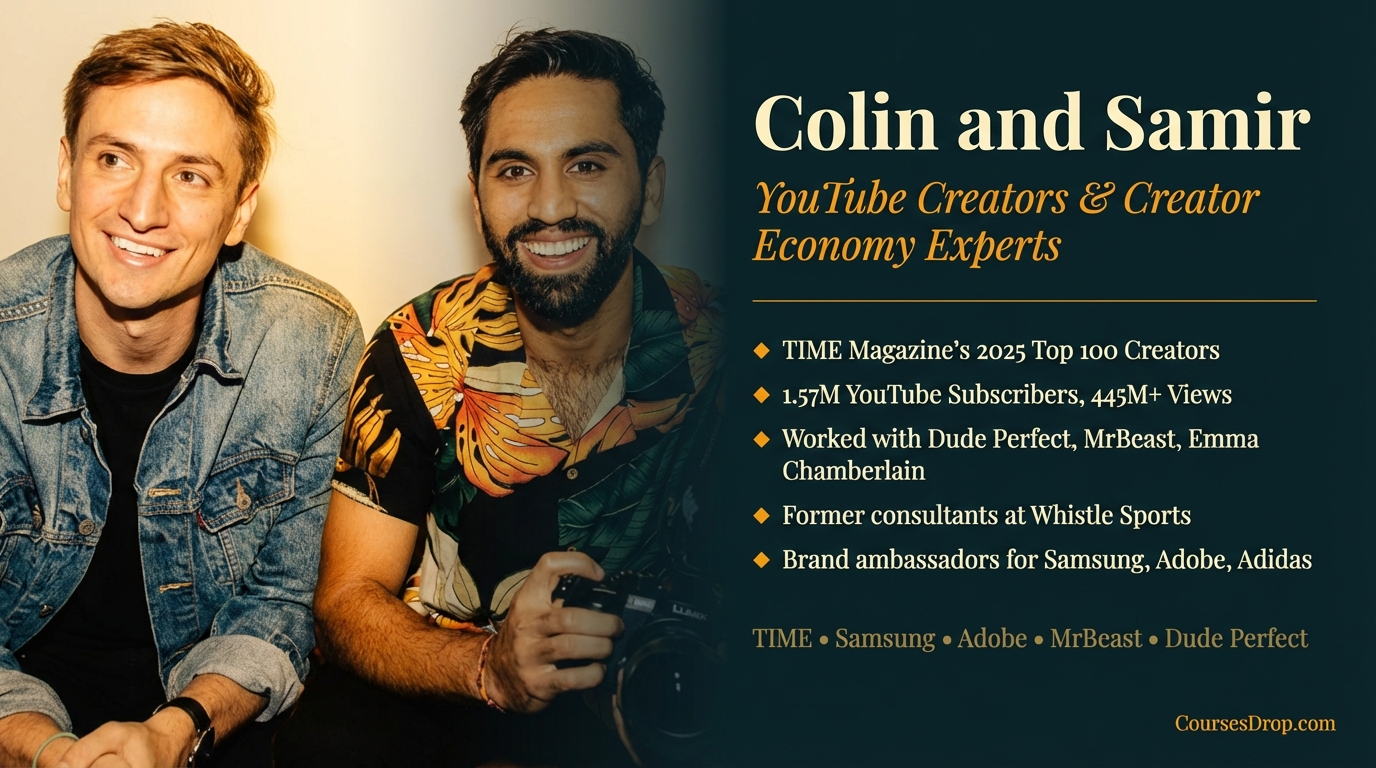
Colin Rosenblum and Samir Chaudry are two of the most credible voices in the creator economy — not because they have the biggest channel (though nearly 1.6 million subscribers is substantial), but because of how they got there and what they do with it.
Their story is worth knowing: they met through lacrosse, built a digital media network called The Lacrosse Network in 2012, sold it to Whistle Sports in 2014, and pivoted to building a creator-focused YouTube channel and podcast. By late 2019, they were making roughly $26,000 per year each and were close to shutting the channel down entirely — they even made a "Goodbye" video. Then Samsung offered them a year-long brand ambassador contract, and everything changed.
That near-failure and recovery is not incidental to the course. It is the foundation of why the curriculum is grounded in real operating pressures rather than theoretical best practices. They have been broke creators. They have negotiated major brand partnerships. They have built a media company. They have interviewed MrBeast, Emma Chamberlain, MKBHD, and dozens of others — not just for content, but to reverse-engineer the systems underneath successful creator businesses.
They are also TIME magazine's 2025 Top 100 Creators. They have done this publicly, transparently, and with receipts.
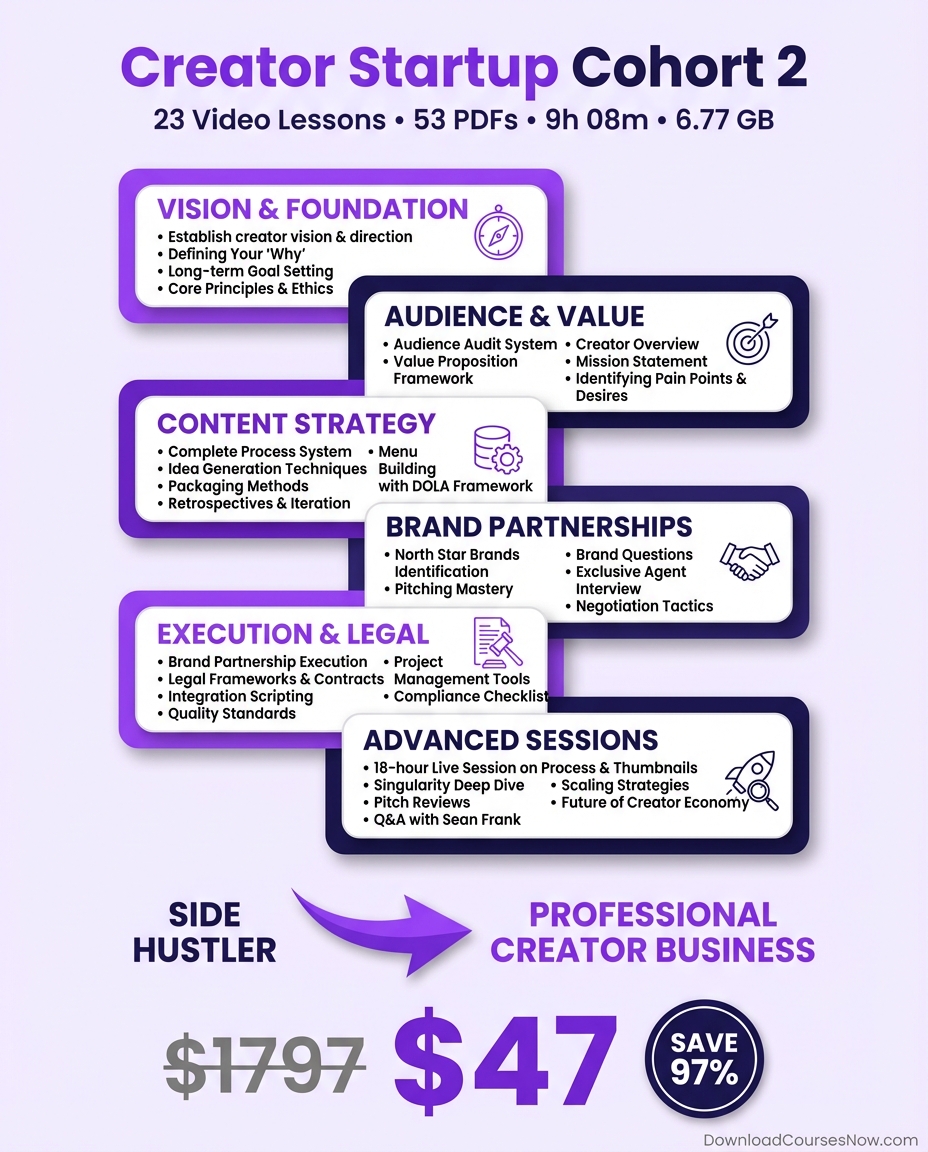
What Is Actually Inside Creator Startup Cohort 2?
The course spans 23 lessons organized around a single central argument: your product is not content — it is access to a hyper-specific audience. And specificity eliminates competition.
Here are the major frameworks you will work through:
The Brand Deal Planner (Floor Price Calculator)
The Brand Deal Planner is Colin and Samir's bottoms-up pricing model — a 6-step floor price calculator built from actual operating expenses. This is the framework most buyers cite as the single most immediately valuable piece of the course.
The formula: add up your total monthly operating expenses, multiply by 1.40 to build in a 40% margin, then divide by how many integrations you can realistically deliver per month. That gives you your floor price per deal. List your rates at 1.5x your floor to build in negotiation room. Assume a 50% fill rate when stress-testing your revenue model, and factor in 10–15% agent commission if applicable.
This is the kind of math that takes about 30 minutes to run and has an immediate, concrete impact on how you enter every deal conversation going forward. If you take nothing else from the course, doing this calculation for your business is worth a significant portion of the price.
The 5 Stages Framework
The 5 Stages of a Creator Startup is Colin and Samir's lifecycle model — a 5-phase diagnostic tool that maps the creator business journey: Exploration, Development, Growth, Expansion, and Diversification. Understanding which stage you are in prevents common mistakes — like trying to optimize your deal flow when you have not yet clearly defined your audience, or spending time on audience definition when you already have strong traction and need to build revenue systems.
Three Brand Motivations
The Three Brand Motivations is Colin and Samir's buyer-side segmentation model with three categories: Awareness, Conversion, and Community Trust. Every brand that wants to work with a creator is driven by one of these three underlying motivations. Understanding which motivation is driving an inbound request changes how you pitch, what you charge, and how you structure the integration. Awareness deals are often commoditized. Community trust deals command significant premiums.
The 6-Box Integration Checklist
The 6-Box Integration Checklist is Colin and Samir's pre-production quality control framework — a 6-point tool that checks whether a brand integration is structured to serve your audience as well as the brand. This matters because integrations that feel inauthentic are not just bad for your audience — they erode the very trust that makes your audience worth reaching in the first place. The checklist is a practical guard against this.
Four Approaches to Singularity
The Four Approaches to Singularity is Colin and Samir's competitive positioning model — a 4-part framework with these categories: format singularity, audience singularity, trust singularity, and access singularity. This is the strategic frame that governs all the tactical work. There are four ways a creator becomes the only logical choice for a brand in a category. The most durable creator businesses have at least two.
The Northstar Brand List and Wrap-Up Email
The Northstar Brand List is a structured list of brands you actually want to work with — built in about 30 minutes, used to make your outreach strategic rather than desperate. The post-campaign wrap-up email is identified as the single most important tool for deal renewal and is the piece most creators skip.
Sean Frank's Perspective
One of the course's most distinctive elements is inside access to how brands actually evaluate and select creators. Sean Frank, CEO of Ridge (a brand spending over $10 million per year on creator partnerships), breaks down exactly what he looks for, how his team finds creators, and why certain creator relationships generate value years after the campaign ends. He cites a 2019 Theo Vaughn integration that still generates Ridge sales today — a real example of the compounding value this course is built around.
The key takeaway is that the brand's perspective, not the creator's pitch mechanics, is what determines whether a deal gets approved. This buyer-side framing is the most distinctive element of the curriculum.
Quick Wins Built Into the Curriculum
Creator Startup Cohort 2 is structured around a series of exercises that produce immediate, tangible outputs:
- Calculate your floor price from expenses — 30 minutes, produces a number you can use in your next negotiation
- Define 3 audience segments — 45 minutes, produces the psychographic foundation for every brand pitch you write
- Screenshot 3–5 best viewer comments — 20 minutes, produces proof-of-engagement evidence for brand conversations
- Build your Northstar Brand List — 30 minutes, produces a prioritized outreach target list
This is one of several interconnected frameworks inside Creator Startup Cohort 2. The complete breakdown — every framework, every limitation — is available on Course To Action. Start free.
What Creator Startup Cohort 2 Does NOT Cover
The main limitation is scope: this is a brand deal course, not a comprehensive creator business course.
There is no coverage of courses, memberships, physical products, licensing, events, or platform monetization (AdSense, YouTube Partner Program). There is no short-form strategy — everything is weighted toward long-form YouTube. The legal advice and brand partnership norms are US-centric, so international creators will need to adapt. The course does not serve Exploration or Development stage creators — it is built for Growth-stage creators and above.
What makes this different from other brand deal courses is the operational depth of what it does cover. But be clear-eyed about what is not here before you commit $1,797.
Read the Full Creator Startup Cohort 2 Breakdown
The course costs $$1,797. The complete breakdown is $49/year.
Start free — 10 full summaries, no credit card
Who Should Buy This Course
Creator Startup Cohort 2 is a strong fit if:
- You have an existing audience — even a small, specific one — and brand deals are a revenue stream you want to build systematically
- You currently price deals by guessing or by looking at what other creators charge, and you want a defensible, math-backed pricing model
- You have gotten brand deal interest but feel uncertain about how to evaluate, negotiate, or structure those deals
- You want to understand how brands like Ridge actually think about creator partnerships from the brand side
- You are building a creator business with the intention of it being your primary income source
Who Should Not Buy This Course
This course is not the right fit if:
- You are pre-audience. The frameworks require an existing viewer or subscriber base to be actionable. If you are still in the "building an audience from zero" phase, start there and return to this course later.
- You are looking for production, editing, or content strategy advice. This course is about the business of creator businesses, not content creation mechanics.
- You want passive study material. The cohort format and the exercise-based curriculum require active engagement. You need to do the work to get the value.
- Brand deals are not your intended revenue model. If you are building toward merchandise, subscriptions, or direct product sales as your primary income, this curriculum is adjacent but not central to your goals.
Is $1,797 Worth It?
The honest answer: it depends on your floor price calculation.
If the Brand Deal Planner shows you that your current rates are 40% below where they should be, and you close one additional or properly-priced deal as a result, the course pays for itself in a single negotiation. For creators who are consistently underselling — which is most creators — the ROI math is not complicated.
If you are pre-audience or not planning to pursue brand deals as a primary revenue stream, $1,797 is a meaningful amount of money to spend on education that will not directly move the needle for your current situation.
The course is rigorous, the instructors are credible, and the frameworks are grounded in real business mechanics rather than aspirational content marketing. For the right creator at the right stage, it is one of the more substantive investments available in this space.
For the wrong creator at the wrong stage, it is a very well-produced course you will not use.
Know which one you are before you buy.
Frequently Asked Questions
Is Creator Startup Cohort 2 worth $1,797?For Growth-stage YouTube creators doing sporadic or under-priced brand deals, the ROI is straightforward: the floor price formula alone frequently reveals that creators are leaving 30-50% on the table per deal. One properly priced negotiation recovers the course price. For pre-audience creators or those not pursuing brand deals as a primary revenue stream, the price is not justified.
What does Creator Startup Cohort 2 actually teach?The course teaches seven frameworks across 23 lessons: the 5 Stages of a Creator Startup (lifecycle diagnostic), the IEA audience definition tool, the Brand Deal Planner (floor price calculator), the 7 Sources of Friction (deal blocker audit), the 6-Box Integration Checklist, the Four Approaches to Singularity (competitive positioning), and the Three Brand Motivations (buyer-side segmentation). Each framework is built around specific exercises that produce deliverables.
What does Creator Startup Cohort 2 NOT cover?The course does not cover course creation, memberships, physical products, licensing, AdSense optimization, or multi-platform monetization. It does not cover short-form content strategy. It does not cover international market dynamics — the legal and brand partnership frameworks are US-centric. It does not address Exploration or Development stage creators.
Who is Creator Startup Cohort 2 best for?Growth-stage YouTube creators with a defined, consistently publishing channel and some brand deal history who want to systematize and price their partnerships correctly. It is also valuable for creator operators running a small team who have never formalized their business infrastructure.
Where can I read a full summary of Creator Startup Cohort 2?The independent, framework-level breakdown of Creator Startup Cohort 2 — including every named framework, honest limitations, and what the course does not teach — is available at Course To Action. Start free at coursetoaction.com.
Before you commit $1,797, start free on Course To Action. The free tier gives you 10 summaries and AI credits — no credit card required. The full breakdown of Creator Startup Cohort 2 is there: every framework, every exercise, every honest limitation.
If you decide to go deeper, Course To Action is $49 for 30 days or $399/year — one payment, no subscription, no auto-renewal — for access to 110+ premium course breakdowns across the creator economy and beyond. Every summary has audio, so you can review the Floor Price Formula or the Three Brand Motivations framework while commuting or training. The AI "Apply to My Business" feature takes any framework from the course and applies it to your specific channel, audience, and revenue situation — so you are not just reading theory, you are getting a personalized starting point before you spend a dollar.
Start free at Course To Action — 10 summaries and AI credits, no credit card required.Course To Action publishes independent framework-level breakdowns of online courses — the 20% that delivers 80% of the value, so you can make an informed decision before you spend a dollar.
Read the Full Breakdown Before You Spend $$1,797
The course costs $$1,797. The complete breakdown — every framework, every lesson, every limitation — is $49/year.
Know exactly what you're getting before you commit. Every module summarised, every action step extracted. Read or listen — every summary has audio.
Start free — 10 full summaries, no credit card required