Before You Buy Coaching on Advanced Topics in Personal Finance by Kelsa Dickey: Everything You Need to Know
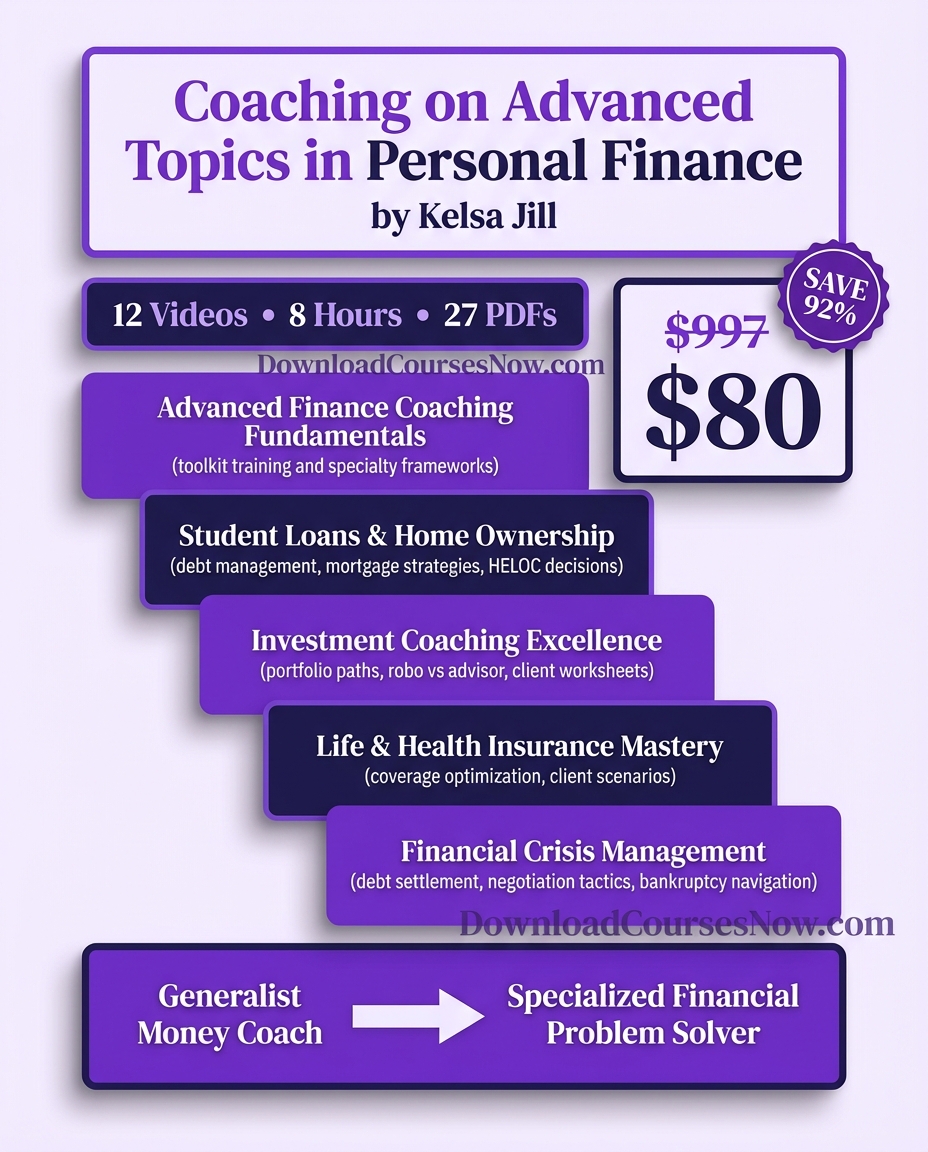
Coaching on Advanced Topics in Personal Finance is a $997 course by Kelsa Dickey, founder of the Financial Coach Academy, covering 12 lessons on how financial coaches can navigate advanced client topics — student loans, investing, debt settlement, HSAs, bankruptcy, and more — using a structured coaching model that keeps them within professional boundaries. The core insight is simple: the coach's power is knowing the questions, not the answers.You are a financial coach. Maybe you're newer, still building confidence with clients. Maybe you've been at this for a few years and things are going well — until a client asks something that stops you cold. An HSA question. A debt settlement question. A student loan refinancing letter they received in the mail. An investment topic that's clearly more complex than budgeting.
You know what you don't know. And you're not sure what to do in those moments — whether to refer out immediately, whether to wade in carefully, whether there's a structure that lets you be genuinely useful without crossing into territory you're not licensed to navigate.
That question — what do I do when a client asks about something advanced? — is exactly what Kelsa Dickey's course, Coaching on Advanced Topics in Personal Finance, is built to answer.
This article is for you, right now, at this moment of decision.
Course To Action is the pre-read: the thing you do before you spend $997 on a course, or the thing you do instead. We have the actual course — all 12 lessons — and we're going to tell you plainly whether the investment is justified for your specific situation. Read the full course breakdown on Course To Action before you decide.
At a Glance
| Field | Detail |
|---|---|
| Course | Coaching on Advanced Topics in Personal Finance |
| Creator | Kelsa Dickey, Financial Coach Academy |
| Price | $997 |
| Content | 12 lessons |
| Best For | Practicing financial coaches who want structured frameworks for advanced client topics |
| Core Topic | How to educate clients on complex financial subjects without crossing into regulated advice |
| Difficulty | Intermediate — assumes you are already coaching clients |
| Skip If | You are not yet coaching clients, you want a general personal finance course, or you want investment certification |
| Verdict | ★★★★☆ — Buy it if advanced client questions are already happening in your practice and you want a repeatable structure for handling them |
What This Course Actually Is
Most financial coaching training teaches you the fundamentals — how to run a budget session, how to talk about debt, how to help a client set goals. These are essential skills, and they work well for a substantial portion of client conversations.
But at some point, every financial coach hits the advanced question problem. A client who's been on a great trajectory suddenly wants to talk about rolling over a 401(k), or they've heard about HSAs and want to understand whether they qualify, or they've gotten three mailers about refinancing their student loans and they want to know if they should act on any of them.
These conversations require a different kind of preparation. Not because the coach needs to become a licensed financial advisor — they don't, and they shouldn't try — but because being useful in these moments requires both factual knowledge of the topic landscape and a coaching framework for navigating it without giving personal financial advice.
Kelsa Dickey has spent over 15 years as a financial coach and has trained hundreds of coaches through the Financial Coach Academy. This course represents her framework for handling the category of client conversation that trips up even experienced coaches: the advanced topic.
The core insight is both simple and genuinely useful: the coach's power in these conversations is knowing the questions, not the answers. The coach doesn't need to tell the client what to do. The coach needs to prepare the client to make a good decision themselves. That reorientation — from advice-giver to preparation facilitator — changes what the coach needs to bring to these sessions and, ultimately, what clients walk away with.
The Frameworks You Are Buying
Three-Phase Coaching Conversation: Educate, Coach, Commit
The Three-Phase Coaching Conversation is Kelsa Dickey's 3-step process for moving through any advanced financial topic with a client while remaining in the coaching role. It is the structural backbone of the course. Every advanced topic client conversation runs through three distinct phases.
Educate: The coach provides the contextual foundation the client needs to think clearly about the topic. Not a recommendation — the landscape. What is this thing? How does it work? What are the key distinctions a client should understand before deciding anything? This phase is about knowledge transfer that makes good decision-making possible. Coach: Once the foundation is in place, the coach shifts to questions. Kelsa distinguishes between objective questions — the facts of the client's situation — and subjective questions — the values, risk tolerance, and priorities that only the client can define. Both are necessary. The objective questions establish the data; the subjective questions establish what the data means for this specific person. A decision that is mathematically optimal for one client may be completely wrong for another with different values and circumstances. Commit: The conversation closes with a specific, time-bound next step that the client owns. Not "think about it" — a named action, attached to a date. This is what separates a useful coaching session from an interesting conversation.Research Phase vs. Decision Phase
One of the course's sharper distinctions: clients approaching a complex topic are in one of two modes. Research Phase clients are still building their understanding. Decision Phase clients have enough information and are ready to move toward a commitment.
The mistake many coaches make is treating every client as if they're in Decision Phase — pushing toward resolution before the client has the context they need. A client who just heard the term "debt settlement" for the first time is not ready to commit to a strategy. A client who has been researching it for three weeks and has a specific situation in front of them is. The course trains coaches to read the difference and calibrate accordingly.
Subjective and Objective Coaching
This framework runs throughout the course as a tool for building complete client conversations. Objective coaching uses facts: numbers, timelines, account types, interest rates, balances. Subjective coaching uses values: what does financial security feel like to this client? What trade-offs are they willing to make? What matters more to them — certainty now or flexibility later?
Both types of questions are necessary. Neither alone is sufficient. The course is structured so that coaches can deploy both with intention, depending on where the conversation is and what the client needs.
The Three Investment Paths
The Three Investment Paths is Kelsa Dickey's categorizing framework for the investing landscape: self-directed investing, fee-only advisor, and traditional advisor. For clients who are beginning to think about investing, coaches can use this framework to orient the conversation without crossing into investment advice. It gives clients a way to understand the space — not a recommendation of which path to take, but a map that makes the territory legible.
Referral Sheet System
The course includes a framework for building a professional referral network: the five categories of professionals a financial coach's clients will eventually need, and how to create a simple one-page referral sheet that becomes a practical tool in client sessions. When the conversation reaches territory that requires a licensed professional, the coach can name that clearly, explain why, and hand the client a resource rather than a vague direction.
This is one of 5 named frameworks in Coaching on Advanced Topics in Personal Finance. The complete breakdown — every framework, every limitation — is available on Course To Action. Start free.
What It Teaches Exceptionally Well
The "prepare, don't advise" principle is genuinely clarifying. For coaches who have felt anxious about advanced topic conversations — either because they were tempted to overstep or because they weren't sure how to be useful without overstepping — this framing resolves the anxiety structurally. The coach's role is not to have the answer. It is to prepare the client to find their own. Once that's internalized, advanced topics become less threatening and more navigable. The specific topic knowledge is substantive. The course doesn't just teach a coaching structure and expect coaches to fill in the financial knowledge themselves. It provides actual content on the advanced topics clients commonly raise — including the triple-tax advantage of HSAs (contributions pre-tax, growth tax-free, withdrawals tax-free for qualified expenses), how debt settlement actually works and what being 90+ days past due means in that context, why refinancing student loan offers received by mail come from private lenders rather than the federal government, and what coaches should understand about the investing landscape before sitting with a client who wants to talk about it. The quick-win exercises are genuinely fast. The course recommends writing out the three phases for your most common advanced topic — an exercise that takes about 30 minutes and immediately improves coach readiness. It also recommends building the professional referral sheet — roughly one to two hours of work that pays off in every subsequent session where a referral becomes appropriate.The key takeaway is that this course is not theoretical — it produces practice-ready outputs coaches can use from day one.
Read the Full Coaching on Advanced Topics in Personal Finance Breakdown
The course costs $$997. The complete breakdown is $49/year.
Start free — 10 full summaries, no credit card
What It Does Not Cover
The main limitation is that the course is not a certification program. It will not make you a licensed financial planner, investment advisor, or tax professional. It is a coaching framework for navigating conversations about topics those professionals cover. The line between coaching and advice remains the coach's responsibility to maintain.
The course assumes you are already coaching. If you are in the early stages of setting up your coaching practice and haven't yet begun working with clients, some of the course's value will feel abstract. The Educate-Coach-Commit framework is most useful when you have real client conversations to apply it to. Advanced tax and legal topics are handled at a referral level, not a depth level. The course teaches coaches when to refer clients to tax professionals, estate attorneys, and financial planners — not how to do the work those professionals do. If you are looking for deep-dive content on tax optimization strategies or legal instruments, this is not that course. Business finance for coaches themselves is not covered. The course is about coaching clients through complex personal finance topics. It is not about the coach's own business finances, pricing, or marketing.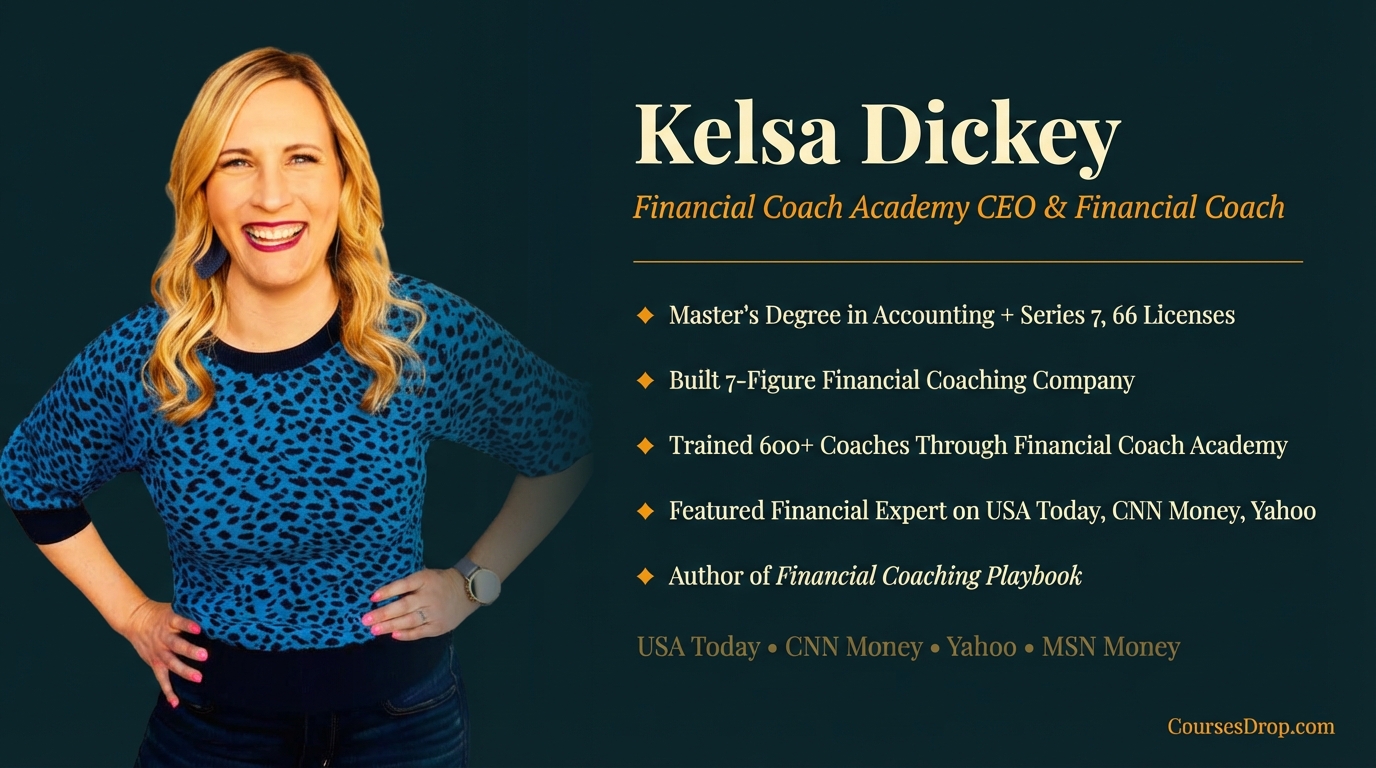
Who Should Buy This
You are exactly right for this course if you recognize yourself here:
You are an actively practicing financial coach and advanced client questions are already happening — or you can see them coming. Your clients are progressing past the basics and starting to ask about investing, debt resolution strategies, tax-advantaged accounts, or loan decisions. You feel some combination of unprepared and uncertain about how to handle these sessions without overstepping.
You are confident in your coaching fundamentals but want a repeatable structure for the harder conversations. You don't need to rebuild your practice from the ground up. You need a framework for the specific category of conversation that currently doesn't have one.
You want to be genuinely useful to clients at a higher level, not just for budgeting basics. You see advanced topic coaching as the difference between a coach clients outgrow and a coach clients keep. This course is designed to keep you relevant as your clients' financial lives grow in complexity.
This is best suited for US-based practicing financial coaches. If you are outside the US, this course's topic-specific content will have limited applicability to your clients.
Who Should Skip This
You are not yet coaching clients. The course's value is rooted in having real client conversations to apply it to. If you are in pre-launch phase, invest in foundational training first and return to this course once client conversations are underway.
You are looking for investment or tax certification. This course will not qualify you to give licensed financial advice. It is a coaching framework, not a certification program.
You are looking for a general personal finance course to improve your own financial knowledge. This course is designed for coaches navigating client conversations, not individuals learning about their own finances.
The Verdict
Buy it if advanced client questions are already showing up in your practice and you want a structured, coach-appropriate way to handle them. The Educate-Coach-Commit framework is genuinely useful, the topic-specific knowledge is accurate and substantive, and the "prepare, don't advise" principle resolves the anxiety that most coaches carry into these conversations without a clear framework for them.
In summary: the $997 price is significant, but the return is proportional. Coaches who can navigate advanced topics confidently retain clients longer, generate stronger referrals, and serve a broader range of client situations without hitting a ceiling. If advanced topics are already costing you client confidence or referral momentum, the course pays back quickly.
Skip it if you are pre-client, seeking certification, or looking for a course about your own finances rather than your clients'.
FAQ
Does this course teach me to give investment advice?No. The course explicitly teaches the opposite — how to be useful in conversations about advanced financial topics without crossing into giving personalized investment or financial advice. The "prepare, don't advise" framework is designed to keep coaches in the coaching role while still providing real value to clients navigating complex decisions.
Do I need to have completed other Financial Coach Academy training first?The course assumes you are already working as a financial coach and have basic coaching fundamentals in place. Prior Financial Coach Academy training is not a prerequisite, but some coaching experience and familiarity with financial coaching fundamentals will make the content land better.
How long does it take to complete?The course contains 12 lessons. The quick-win exercises embedded in the course — the 30-minute Educate-Coach-Commit mapping exercise, the 1-2 hour referral sheet, the 15-minute 1% savings rate challenge — are designed to produce immediate, practical outputs rather than requiring weeks of processing before anything changes in your practice.
What's the refund policy?Verify current terms directly on the course sales page before purchase, as policies can change. Check the course page at coursetoaction.com for the most current information.
Is this course US-specific?Yes. The course is built entirely around US financial structures — federal student loan programs, US bankruptcy law, US tax-advantaged accounts. If your clients are primarily outside the US, this course will not serve you well.
Before you spend $997 on this course, read the full breakdown on Course To Action. Free account — 10 summaries, no credit card required. We have every framework Kelsa teaches across all 12 lessons, the topic-specific knowledge content, the coaching conversation structures, and an honest map of who the course serves and who it doesn't.
Not cliff notes. Full deconstructions. We have the courses. Not the clips. Not the podcasts. The courses. Every summary includes audio, and the "Apply to My Business" AI tool lets you tell the AI about your coaching practice and get a custom advanced-topics preparation plan.
Want all 110+ courses on the platform? It's $49/30 days — one payment, no auto-renewal.
Read the Full Course Breakdown on Course To Action — free account, no credit card. Course To Action publishes independent framework-level breakdowns of online courses — the 20% that delivers 80% of the value, so you can make an informed decision before you spend a dollar.Read the Full Breakdown Before You Spend $$997
The course costs $$997. The complete breakdown — every framework, every lesson, every limitation — is $49/year.
Know exactly what you're getting before you commit. Every module summarised, every action step extracted. Read or listen — every summary has audio.
Start free — 10 full summaries, no credit card required