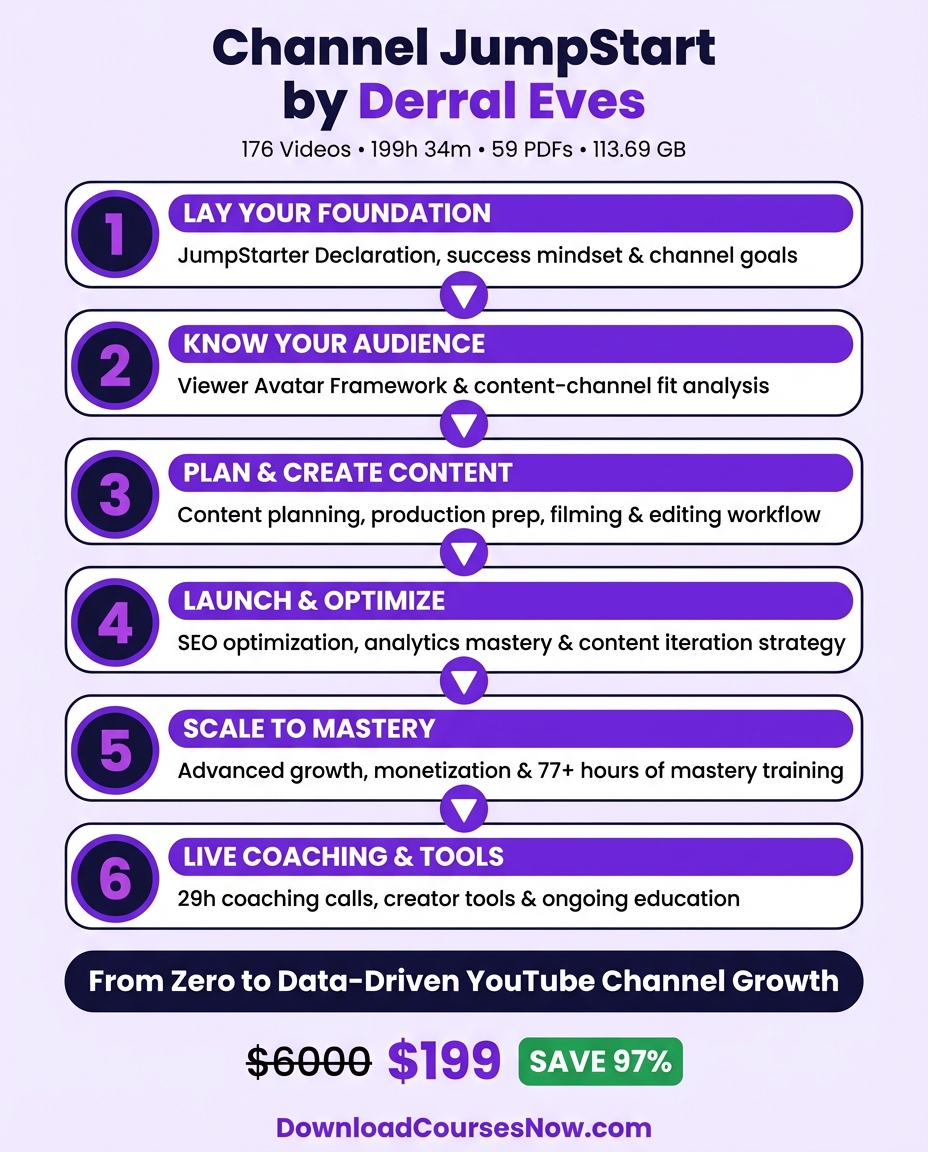
Before You Buy Channel JumpStart by Derral Eves: Everything You Need to Know
Channel JumpStart is a $6,000 course by Derral Eves that teaches a complete, data-driven operating system for YouTube channel growth across 86 lessons and 49.5 hours of instruction. It is the right investment if you are serious about YouTube as a business platform and want a repeatable, systems-based approach to growth. It is the wrong investment if you want quick tactics, post casually, or edit outside Adobe Premiere Pro.
Course: Channel JumpStart Creator: Derral Eves Price: $6,000 Lessons: 86 Total Runtime: 49.5 hours Course URL: https://coursetoaction.com/The full independent framework-level breakdown of Channel JumpStart — every framework documented, every limitation noted — is available at Course To Action. Start free.
Who Is Derral Eves?
Before we talk about whether this course is worth six thousand dollars, you need to know who you are buying from.
Derral Eves is not a YouTube educator who built a modest following and packaged up his experience into a course. He is, as Search Engine Journal called him, the "godfather of YouTube optimization." His client list includes Bill Gates, Epic Games, ABC, NBC, and ESPN. He has generated over 100 billion views across his clients' YouTube and video content. He founded VidSummit, the annual conference that gathers the top creators and video marketers in the industry. He executive-produced The Chosen, the highest crowd-funded TV series in history, and built its audience almost entirely through strategic YouTube distribution.
He also wrote The YouTube Formula, a full-length book published through Wiley that MrBeast, one of the most successful YouTubers alive, personally endorsed with: "Whether you have 5 subscribers or 5 million, you can learn how to be successful on YouTube by reading Derral's book."
This is not someone who learned YouTube from a course. This is someone who has been behind the scenes of some of the most significant channel growth stories of the last decade.
What Channel JumpStart Actually Teaches
The course has 86 lessons across 49.5 hours of instruction. That is a serious body of work. But what makes it distinctive is not the volume — it is the core insight that runs through everything Derral teaches.
Most YouTube creators have been optimizing for the wrong thing.
The dominant advice in creator education circles has been to optimize for search: find the right keywords, structure your titles and descriptions for SEO, chase search rankings. It sounds logical. But here is the problem: YouTube search accounts for fewer than 7% of total views on the platform.
Where does the other 93% come from? Primarily from browse features and suggested videos. YouTube's homepage feed and the "up next" sidebar together drive roughly 80% of all views on the platform. When YouTube decides your video is worth recommending to someone who has never heard of you, that is when channels grow. That is when views compound.
Derral reframes the entire game around this reality. The question is not "how do I rank for this keyword?" The question is "how do I make YouTube's recommendation engine want to show my video to more people?" And the answer to that question is fundamentally about viewer satisfaction — watch time, click-through rate, and what happens after someone watches your video.
The key takeaway is this: this reframe — stop thinking about the algorithm, start thinking about the viewer — is the intellectual backbone of Channel JumpStart.
The Core Frameworks
The most important framework is the Jumpstarter Way — Eves' Plan-Execute-Analyze-Adjust (PEAA) cycle that governs the entire course. It is a four-phase process for treating YouTube growth as a managed system: Plan your viewer and content categories, Execute with consistency, Analyze performance data against baselines, and Adjust with the distinction between quick Speedboat changes and major Ocean Liner pivots.
Beyond PEAA, the course teaches:
The Viewer Avatar — Eves' psychographic profiling framework for defining your ideal viewer not by demographics but by beliefs, fears, and content consumption patterns. The Recon Account Method is its tactical implementation: create an anonymous viewer account to experience YouTube as your target audience does. The Content Buckets System — Eves' framework for structuring a channel around five to seven repeatable content formats, each defined by a consistent theme, title pattern, and visual style, so YouTube's algorithm can identify and surface related videos together as a compounding cluster. The Target Video Strategy — A framework for distinguishing videos designed for audience acquisition (new viewers) from videos designed for audience retention (existing subscribers), and optimizing each type accordingly. The Story Arc (Hook-Enticement-Setup-Re-engagement-Climax-Gush-Wrap) — Eves' seven-stage video structure designed around viewer retention psychology. Each stage serves a specific function in maintaining viewer attention from click to end-screen. ABC Storytelling — A framework governing content ratios within the Story Arc: A-Story (60-70%, the main content), B-Story (20-25%, personality and human moments that build parasocial connection), and C-Story (brief re-engagement callbacks). The 90-Day Lens and Baseline Analysis — Eves' method for reading analytics in rolling 90-day windows rather than video-by-video, to prevent noise from corrupting trend data.
The Case Studies That Matter
Derral does not teach theory in a vacuum. He teaches it through documented outcomes.
Santiago is one of the most striking examples. He came into the Channel JumpStart system with 500 monthly views. After working through the methodology — content buckets, viewer psychology, optimizing for browse and suggested rather than search — his channel reached 38 million monthly views. That is not a modest improvement. That is a channel that became genuinely viable, the kind of numbers that build a real business.
Kristina Smallhorn is another case worth examining. She was at around 30,000 monthly views and applied Derral's content bucket strategy to the modular homes niche. Within 10 days her channel had grown to 62,000 monthly views. The topic sounds narrow. That is exactly the point. Specific, well-defined content buckets consistently outperform broad, unfocused channels because YouTube's recommendation system can identify your audience and serve your videos to more people like them.
This is one of 6 frameworks in Channel JumpStart. The complete breakdown — every framework, every limitation — is available on Course To Action. Start free.
The Three Quick Wins Worth Knowing
Derral structures early course material around fast, actionable steps you can take before you have finished the program. Three of them are worth highlighting here.
The Recon Account takes about 30 minutes to set up. This is a secondary YouTube account you use purely for research — you train it to show you the browse feed and suggested videos that your target audience actually sees. Most creators have no idea what the homepage looks like for their ideal viewer. The Recon Account fixes that blind spot. Average Views Per Viewer is a metric buried inside YouTube Analytics that almost no one checks. It takes about 20 minutes to find and understand. It tells you how many times your existing subscribers are returning to watch your content. A high number means your audience is engaged and returning; a low number means you are attracting one-time viewers who do not come back. This single metric will tell you more about your channel's health than subscriber count ever will. Five to Ten Title Variations is an exercise that takes 15 minutes and changes how you think about every video you make. Before committing to a title, Derral teaches you to write multiple alternatives and evaluate them against what a viewer would actually click in a browse feed. Not "what keywords are in this title?" but "would a real person stop scrolling for this?"Read the Full Channel JumpStart Breakdown
The course costs $$6,000. The complete breakdown is $49/year.
Start free — 10 full summaries, no credit card
What You Need to Know Before Buying
The $6,000 price is real and it is substantial. This is not a $97 beginner course. Derral positions this at the level of serious professional investment — the kind of thing a creator makes when they are treating their channel as a business, not a hobby. Before you buy, you should have a clear answer to the question: what does a working channel mean for my revenue? If a functioning YouTube channel could reasonably generate $50,000 to $100,000 or more in a year for your business, $6,000 for expert instruction is a defensible number. If you are exploring YouTube casually, this is not the right entry point. The course has 86 lessons and 49.5 hours. That requires real commitment. This is not something you consume over a weekend and implement on Monday. Creators who get the most from Channel JumpStart typically treat it like a serious educational program — scheduled time, notes, and implementation between modules. Derral's methodology is system-oriented. It is not about going viral once. It is about building a content structure — what he calls content buckets — that makes your channel consistently recommendable over time. If you are looking for a hack or a shortcut to a single breakthrough video, this is not designed for that.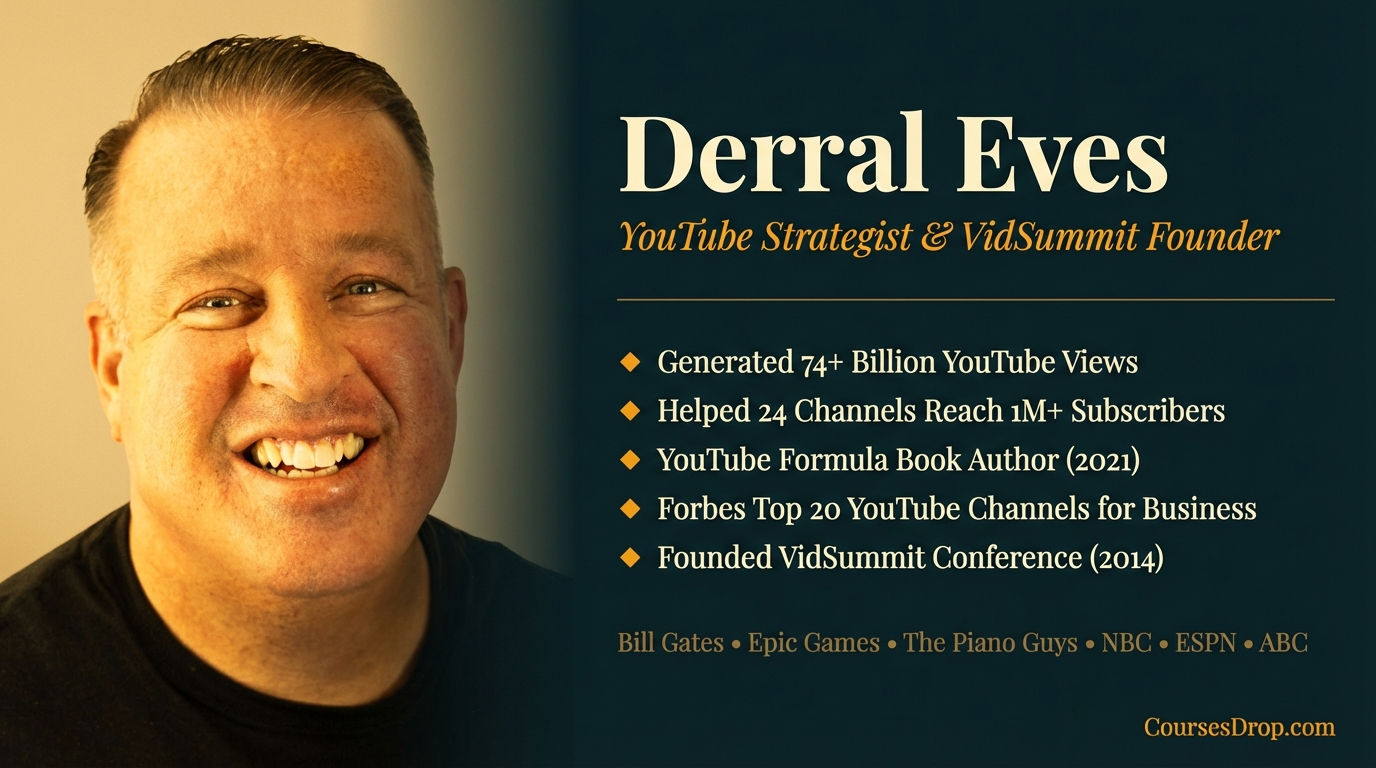
What Channel JumpStart Does Not Cover
The main limitation is what no other review will tell you: what the course skips entirely.
Monetization beyond AdSense is absent. Channel JumpStart teaches you how to grow a YouTube audience. It does not teach you how to monetize that audience beyond the standard revenue share. No sponsorship negotiation, no merchandise, no course creation, no community memberships. Premiere Pro is the assumed editing environment. Technical editing instruction is built around Adobe Premiere Pro. If you edit in Final Cut, DaVinci Resolve, or CapCut, the editing-specific lessons will require translation. YouTube Shorts creators will find limited applicability. The frameworks are built around long-form YouTube content. Short-form vertical video operates on different psychological and algorithmic mechanics. Some content redundancy across 86 lessons. At 49.5 hours, expect some overlap. Concepts are revisited across modules, sometimes without meaningfully advancing the prior lesson.Who This Course Is Best Suited For
This is best suited for:
- Creators who have already started a channel and are not seeing the growth they expected
- Business owners who use or want to use YouTube as a primary marketing channel
- Content professionals who want a deep, expert-level understanding of how YouTube's recommendation system actually works
- Anyone who has been focusing primarily on SEO and search and is not satisfied with the results
- You have not yet decided what your channel is about
- You are unwilling or unable to invest 49.5 hours of focused study
- You are not prepared to rebuild your content strategy based on new information
- You need monetization strategy alongside audience development
The Bottom Line
Channel JumpStart is a premium course at a premium price, built by someone with genuine credentials at the highest level of the industry. The core insight — that 80% of YouTube views come from browse and suggested, not search, and that most creators are optimizing for the wrong 7% — is not a gimmick. It is a structural reality about how the platform works, and it changes everything about how you should approach content strategy.
What makes this different is the depth of the framework architecture. The case studies are real. The methodology is documented. The instructor's track record is verifiable.
If you are serious about YouTube as a business tool and you are ready to treat this as a professional investment rather than an impulse purchase, Channel JumpStart is worth a hard look.
Frequently Asked Questions
Is Channel JumpStart worth $6,000?For creators and entrepreneurs who are serious about YouTube as a primary platform, yes — the course delivers a complete growth operating system from one of the most credentialed practitioners in the field. For casual creators or those exploring YouTube as a side project, $6,000 is not calibrated to that level of commitment. The answer depends entirely on how central YouTube is to your business or career goals.
What does Channel JumpStart actually teach?Channel JumpStart teaches 6+ named frameworks across 86 lessons: the Jumpstarter Way (PEAA cycle), the Viewer Avatar with Recon Account Method, the Content Buckets System, the Target Video Strategy, the Story Arc (7-stage retention structure), ABC Storytelling ratios, and the 90-Day Lens for analytics interpretation. The central thesis is that YouTube's algorithm is a measurement of viewer behavior — not an independent force — and growth comes from serving the viewer, not gaming the metric.
What does Channel JumpStart NOT cover?The course does not cover monetization beyond AdSense basics — no sponsorship negotiation, merchandise strategy, or course creation. Editing instruction assumes Adobe Premiere Pro; other platforms require translation. YouTube Shorts-specific strategy is absent. Some content is redundant across the 86 lessons.
Who is Channel JumpStart best for?Creators and business owners who are committed to YouTube as a primary platform, want a systematic data-driven approach rather than intuition-based content creation, and have the resources — $6,000 and 49.5 hours — to invest in a complete foundational education.
How does Channel JumpStart compare to free YouTube advice?Free YouTube education is overwhelmingly focused on search SEO — the mechanism that drives fewer than 7% of views. Channel JumpStart is built around the other 93%, primarily the browse and suggested mechanics that drive 80% of platform views. The framework depth, case study documentation, and Derral Eves' verifiable track record at scale are not available in free educational content.
Where can I read a summary of Channel JumpStart before buying?The complete independent breakdown — every framework extracted, every lesson documented, every limitation noted — is at Course To Action. Not a review. Not cliff notes. A full framework-level deconstruction. Start free.
The course costs $6,000. Before you spend that, read the complete independent breakdown at Course To Action — every framework documented, every limitation noted.
Start with a free account: 10 summaries, AI credits, no credit card required. Or get all 110+ premium courses, audio summaries, and the "Apply to My Business" AI tool for $49/30 days. One payment, no auto-renewal.
The AI has read the entire course — tell it about your YouTube channel and get a custom growth strategy. Or read the summary, or listen to the audio version — your call.
Full breakdown at Course To Action — free account, no credit card.Course To Action publishes independent framework-level breakdowns of online courses — the 20% that delivers 80% of the value, so you can make an informed decision before you spend a dollar.
Read the Full Breakdown Before You Spend $$6,000
The course costs $$6,000. The complete breakdown — every framework, every lesson, every limitation — is $49/year.
Know exactly what you're getting before you commit. Every module summarised, every action step extracted. Read or listen — every summary has audio.
Start free — 10 full summaries, no credit card required