Before You Buy Cash Flow Planning and Control for Small Business Owners by Kelsa Dickey: Everything You Need to Know
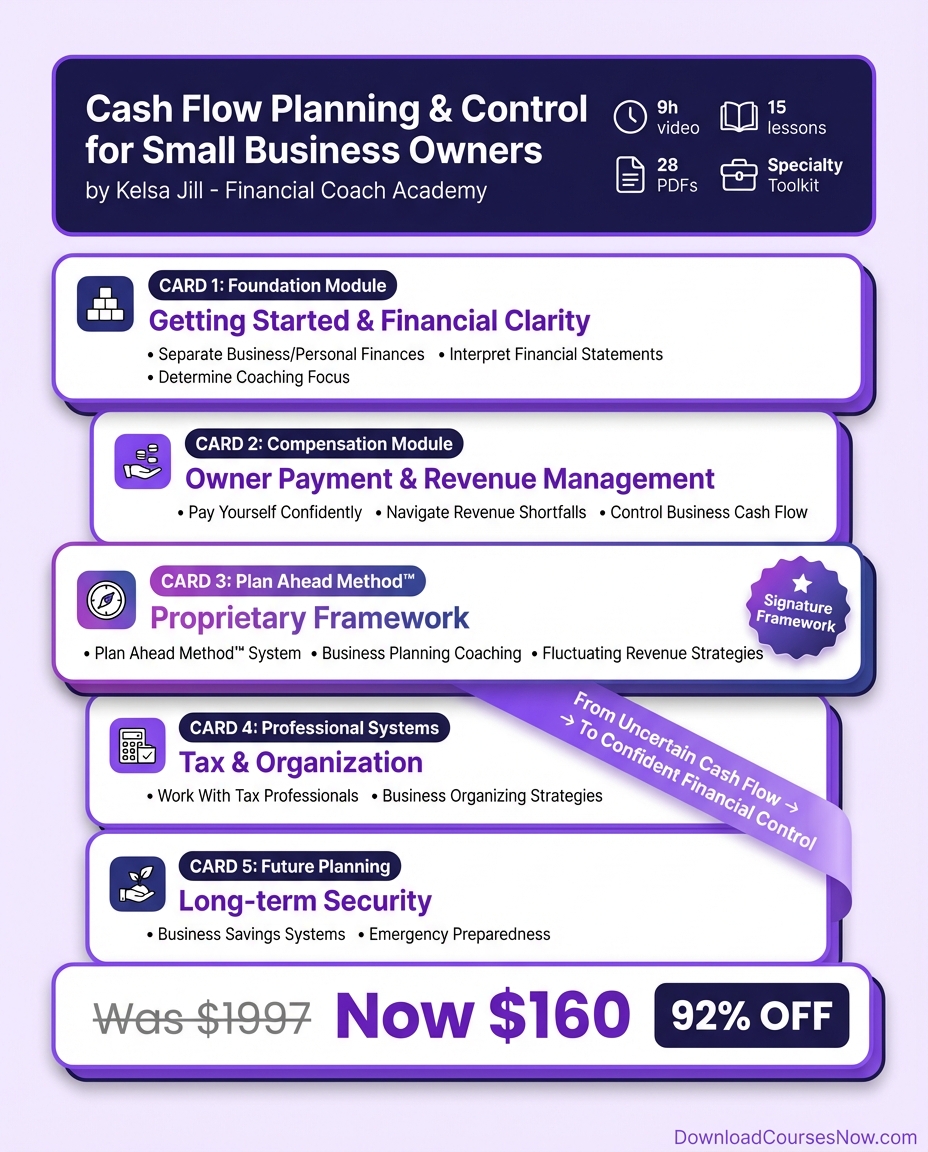
Cash Flow Planning and Control for Small Business Owners is a $1,997 course by Kelsa Dickey that teaches service-based business owners and financial coaches how to build a complete cash flow system using the Plan Ahead Method™ and 6 supporting frameworks across 15 lessons. Before you spend $1,997, here's a clear-eyed look at what's inside, who it's built for, and what you'll be able to do differently on the other side.
You're pulling in real revenue. Some months are genuinely good. But when you sit down to pay yourself — or plan a hire, or decide whether you can afford that software subscription — you hesitate. Because you don't actually know where you stand.
That's not a revenue problem. That's a visibility problem. And it's exactly what Kelsa Dickey built this course to solve.
According to the full course breakdown on Course To Action, this is one of the most complete cash flow toolkits available for service-based business owners and the coaches who serve them.
Who Is Kelsa Dickey?
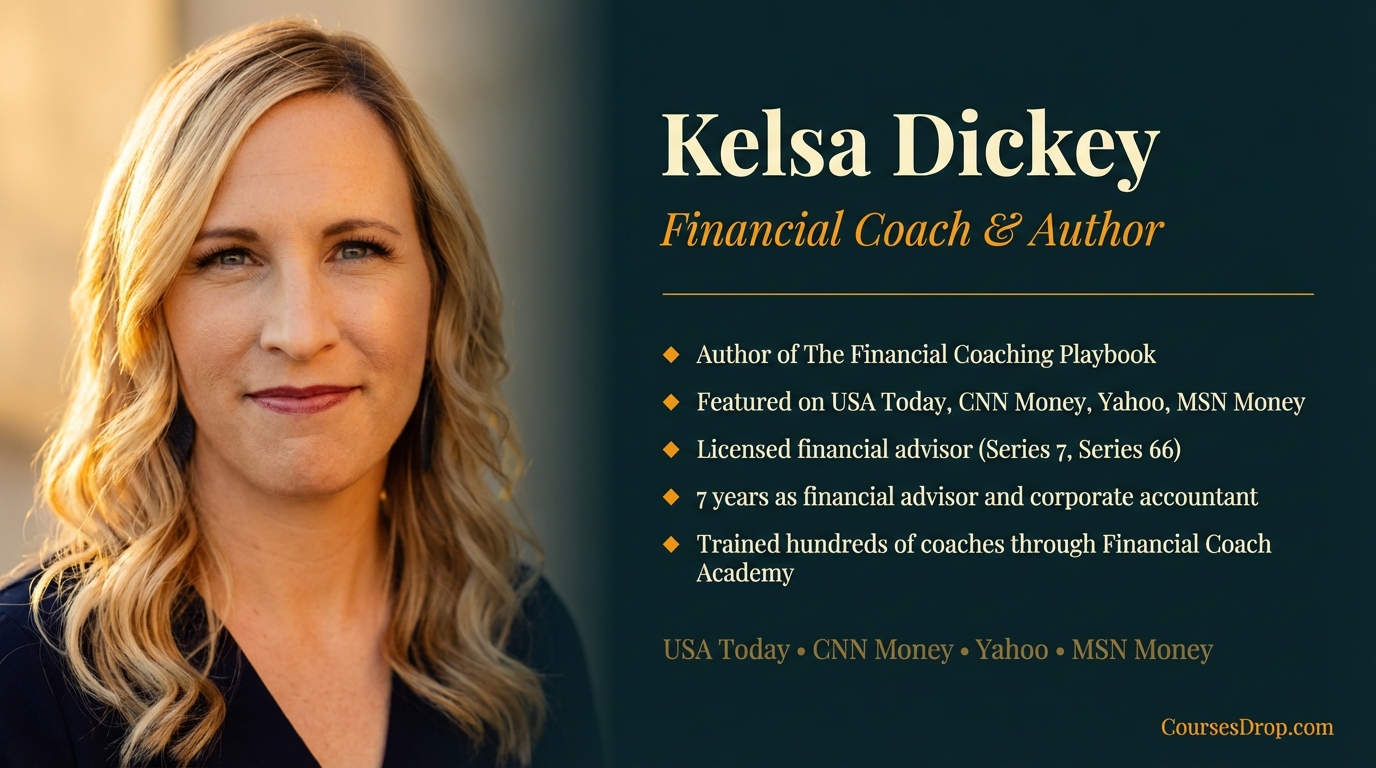
Kelsa Dickey is the CEO and co-founder of Fiscal Fitness Phoenix, a financial coaching company she launched in 2008 after years working in corporate finance and earning an MBA in accounting. Her path into financial coaching wasn't purely academic — it was personal. Growing up, she watched her family navigate financial hardship and her mother's bankruptcy. That experience became the foundation for a coaching philosophy that combines analytical rigor with a realistic understanding of how money stress actually works.
Over the past 15+ years, Kelsa and her team at Fiscal Fitness have worked with hundreds of business owners, couples, and professionals. She's the creator of the Plan Ahead Method™ — a forward-looking system for managing cash that replaces traditional reactive budgeting with proactive planning. Her clients have collectively paid off over $1 million in debt and saved hundreds of thousands of dollars.
She's not a guru selling a mindset shift. She's a trained financial professional who coaches you through concrete, repeatable systems.
What the Course Is About
The core premise is blunt: most small business owners can't make smart decisions because they can't see their numbers clearly. Revenue goes into one account, expenses come out, and the owner pays themselves whatever's left — which some months is nothing.
The course addresses this by teaching you to:
- Separate your money into the right accounts so each dollar has a designated purpose
- Calculate your minimum revenue target so you know exactly what the business must bring in each month
- Pay yourself a real paycheck on a real schedule, eliminating the "I'll pay myself when there's extra" trap
- Set aside taxes automatically so they stop being an emergency
Key Frameworks Inside the Course
The Plan Ahead Method™The Plan Ahead Method™ is Kelsa Dickey's rolling, forward-looking cash flow system built in Google Sheets. The core mechanism: revenue at the top of each column, expenses listed below, and an ending balance that automatically rolls into the next period's starting balance. Five distinct layout variations are taught — Simple Bi-Weekly, Weekly with X-Marking, Deposit Account Layout, Operating and Fixed Split, and Credit Card Integration — so the system can adapt to different business stages and complexity levels. What makes this different from standard budgeting is that it is forward-facing by design: instead of asking "where did my money go?" you see where it's going before it arrives.
The Deposit Account StrategyThe Deposit Account Strategy is Kelsa Dickey's structural solution to lumpy, irregular revenue. Revenue lands in a separate deposit account; fixed, scheduled transfers move money into the operating account on a set cadence. This smooths volatile project-based income into predictable operating cash flow. One of the quick wins built into the course is opening an Ally savings account with three sub-buckets — a task that takes about 30 minutes and immediately changes how you relate to your cash.
Compensation ProgressionThe Compensation Progression is Kelsa Dickey's structured framework for moving from erratic owner draws to a planned paycheck. The stages run: Base Salary → Monthly Flat Bonus → Profit-Based Bonus → Quarterly Profit Share → Profit First. The progression maps out the milestones that justify each increase in compensation, preventing both the trap of never paying yourself and the error of jumping to Profit First before the foundational stages are stable.
The 25% Tax Savings RuleThe 25% Tax Savings Rule is Kelsa Dickey's simple, consistent approach to tax reserves: every time you transfer money to yourself, move 25% of it into a dedicated tax savings bucket. No calculation required, no quarterly scramble. The rule is simple enough to execute in the moment and accurate enough to keep you out of trouble. The course also touches on a related threshold: once you're consistently earning $60,000 or more annually from your business, it's worth talking to an accountant about an S-corp election — a structural change that can save approximately $7,650 per year on $100,000 in income.
This is one of the key frameworks in Cash Flow Planning and Control for Small Business Owners. The complete breakdown — every framework, every limitation — is available on Course To Action. Start free.
What You'll Actually Do
The course is 15 lessons and built around implementation, not theory. Three quick wins are embedded early so you see results before you finish:
- Pull 12 months of revenue by month (about 20 minutes): This single exercise shows you your actual revenue patterns — peaks, valleys, and the true baseline you're working with.
- Calculate your minimum revenue target in a spreadsheet (about 45 minutes): You'll land on a specific number — the floor the business must clear every month for you to cover all obligations, pay yourself, and set aside taxes.
- Open an Ally savings account with 3 buckets (about 30 minutes): You'll create the structural separation that makes the whole system work.
The key takeaway from the course's structure is this: the minimum revenue target calculation alone converts months of financial anxiety into a single actionable number. Once you have that floor, every other financial decision becomes readable in context.
Read the Full Cash Flow Planning and Control for Small Business Owners Breakdown
The course costs $$1,997. The complete breakdown is $49/year.
Start free — 10 full summaries, no credit card
A Note on the Budget Shortfall Piece
One thing worth flagging: the course emphasizes that most apparent cash flow problems don't require a revenue breakthrough to fix. Small budget adjustments — trimming subscriptions, renegotiating vendor terms, timing payments differently — often resolve shortfalls before you need to go out and find more clients. This matters because a lot of business owners assume the answer to every financial squeeze is "sell more." Kelsa's framework shows you how to diagnose whether that's actually true before you add that pressure.
Who This Course Is For
This is best suited for you if you:
- Run a small business and pay yourself inconsistently or reactively
- Feel like you make decent money but have nothing to show for it
- Dread tax season because you haven't set anything aside
- Want a repeatable system, not just a spreadsheet someone else built
- Are past the startup phase and ready to run your finances like a real business
- Are a financial coach who needs a deployable methodology for business owner clients
- Are pre-revenue or in the first 60 days of your business (you don't have enough data yet to make the minimum revenue target exercise meaningful)
- Already have a CFO or fractional financial officer handling this — you're likely operating at a complexity level beyond what this course addresses
- Are looking for investment strategy or wealth-building content (this course is specifically about cash flow management and owner compensation)
- Sell physical products or operate in e-commerce (the frameworks are calibrated for service businesses)
- Are outside the United States (tax content is US-specific)
What It Doesn't Cover
This is what most pre-purchase reviews skip. The main limitation is that the course is entirely about managing money once it arrives — there is no revenue generation content. If your core problem is not enough clients, inadequate pricing, or weak sales conversion, this course does not solve that problem. The frameworks only function once there is revenue to plan around.
The course is also US-specific for tax content, scoped to service businesses rather than product businesses, and does not include PDF workbooks — coaches will need to build their own client-facing materials. Businesses above $1M will find the frameworks address foundations they likely already have.
The $1,997 Question
At $1,997, this is not an impulse purchase. But let's put it in context.
The 25% tax savings rule alone — implemented consistently over a year — eliminates what's typically a $5,000 to $20,000 surprise depending on your revenue. The S-corp conversation, if it applies to you, is worth approximately $7,650 annually in self-employment tax savings. Paying yourself consistently means you stop making personal financial decisions based on business cash flow anxiety — that has a compounding quality-of-life value that's hard to put a number on.
The more useful question isn't whether the math works. It's whether you will implement it. The course is built around quick wins and concrete tasks specifically because Kelsa understands that financial systems only work if they're simple enough to actually run. If you'll do the work, the return is real. If you're looking for information without implementation, any course at this price point is the wrong investment.
Bottom Line
Cash Flow Planning and Control for Small Business Owners is a practical, framework-driven course from a credentialed financial coach with 15+ years of real-world experience working with business owners. It addresses a specific, high-stakes problem — the gap between revenue and financial clarity — with concrete systems you can set up in a weekend.
The price is significant. The problem it solves is more so.
If you're ready to stop guessing and start running your business finances with intention, this is a serious course built by someone who knows exactly what that transition requires.
Before you spend $1,997, read the full breakdown on Course To Action — free account, 10 summaries, no credit card required. The AI has read the entire course and can generate a custom action plan for your business finances. Every summary includes audio so you can listen instead of read. Or unlock all 110+ premium courses for $49/30 days — one payment, no auto-renewal.
Not a review. Not a rating. A complete framework-level analysis so you know exactly what you're buying — or whether you need to buy it at all — before you spend $1,997.
Course To Action publishes independent framework-level breakdowns of online courses — the 20% that delivers 80% of the value, so you can make an informed decision before you spend a dollar.Read the Full Breakdown Before You Spend $$1,997
The course costs $$1,997. The complete breakdown — every framework, every lesson, every limitation — is $49/year.
Know exactly what you're getting before you commit. Every module summarised, every action step extracted. Read or listen — every summary has audio.
Start free — 10 full summaries, no credit card required