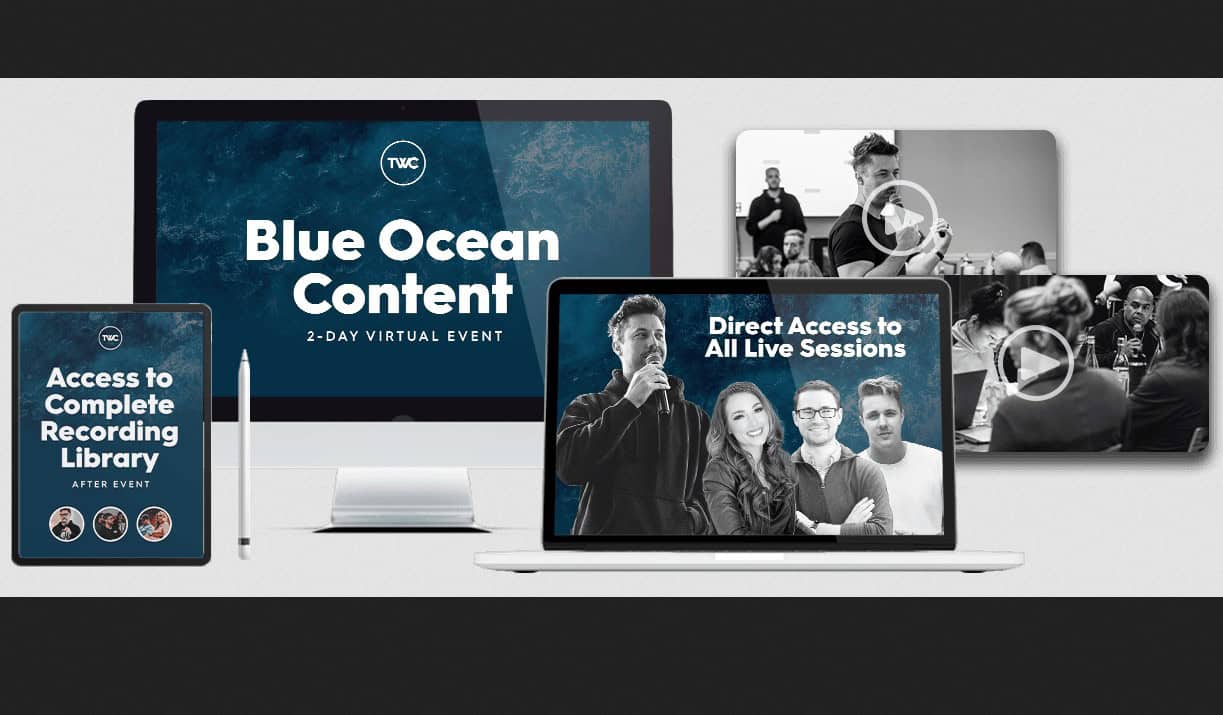
Before You Buy Blue Ocean Content YouTube Mastery by Taylor Welch: Everything You Need to Know
Before you spend $1,000 on Blue Ocean Content YouTube Mastery by Taylor Welch, you deserve a straight answer about what you're actually getting — and what you're not. Blue Ocean Content YouTube Mastery is a $1,000 workshop by Taylor Welch covering 8 sessions (approximately 10 hours) on YouTube positioning, algorithm optimization, and interdisciplinary branding for founders and entrepreneurs. This is not a hype piece. It's a structured look at the course content, who it serves, and whether the price is justified for your specific situation.
For the independent, framework-level breakdown of every session, see Course To Action.
At a Glance
| Creator | Taylor Welch |
| Price | $1,000 |
| Format | 8 sessions of video instruction |
| Total Hours | ~10 hours |
| Difficulty | Intermediate |
| Best For | Entrepreneurs, coaches, and consultants who want YouTube to work as a client acquisition channel, not just a content archive |
| Skip If | You want a Shorts strategy, you're looking for monetization tactics beyond ad revenue, or you're uncomfortable with a spiritually integrated framework |
What You'll Learn
Blue Ocean Content YouTube Mastery is built around a single contrarian thesis: novelty drives content success, not information. The course argues that most YouTube channels fail not because they lack knowledge, but because they're indistinguishable from every other channel in their space. The solution is not to double down on information density — it is to find the unusual angle that only you can occupy.
The core insight is that the YouTube algorithm rewards compulsive re-engagement, and that compulsive re-engagement is produced by genuine novelty — specifically, the kind of novelty that comes from combining unrelated expertise domains in a way no other creator can replicate.
The course delivers that through several interconnected frameworks:
TAM vs. Niche × Depth Matrix — A tool for mapping your topic area against two axes: total addressable market and niche specificity. The goal is to avoid both the overcrowded middle of broad markets and the dead end of niches too small to matter. Welch teaches how to find the positioning quadrant where meaningful audiences exist but competition is thin. This is Taylor Welch's 4-quadrant framework for positioning a YouTube channel: the horizontal axis plots audience breadth (TAM to niche) and the vertical axis plots content depth (shallow to deep). The Blue Ocean target is large audience + deep, specific angle. Interdisciplinary Branding — The central methodology of the course. Most creators build a channel around a single area of expertise. Welch argues this is a structural mistake. The Interdisciplinary Branding framework is Welch's 4-stage method: (1) list five topics you genuinely care about with no business restrictions, (2) select the top three, (3) identify the connecting thread between them, (4) build your content identity at that intersection. That thread is your actual channel identity — the thing no competitor can replicate because no competitor has your exact combination of experiences. 3Cs Framework — A model built around YouTube's algorithm mechanics. The 3Cs Framework is Welch's system for engineering 60% Average View Duration (AVD) — the specific threshold at which YouTube's recommendation algorithm shifts from limited-audience testing to broad distribution. The framework organizes content decisions — topic selection, structure, pacing — around achieving and sustaining that threshold. The key metric: Capture (thumbnail + title + first 30 seconds), Captivate (sustained retention through full runtime), Convert (action at the end). TV Show Channel Framework — A structural approach to channel architecture. Rather than treating each video as a standalone piece, this framework builds a channel the way a television network builds a lineup: themed series, predictable formats, episode-to-episode continuity. The goal is to make subscribing feel like signing up for something, not just bookmarking a video.The Quick-Win Exercises
One of the more useful aspects of the course is how it operationalizes its frameworks into time-bounded exercises you can run immediately.
The Interdisciplinary Branding exercise takes roughly 30 minutes. List five topics you love — no business restrictions, no commercial filter applied. Pick the top three. Find the connecting threads. That exercise, done honestly, produces a channel positioning that is both authentic and differentiated. Most people who have been stuck trying to find their "niche" discover that they've been thinking about the question wrong.
The title audit exercise is faster. Pull your last five YouTube video titles. Check whether each one is under 75 characters. Check whether any start with your podcast or show name. If they're over 75 characters or front-loaded with your brand name, they're working against the algorithm regardless of how good the content is. This is a fixable problem that takes minutes to address once you know what to look for.
The ChatGPT audience research protocol takes about 20 minutes and produces the kind of granular audience language — the specific phrases, fears, and aspirations of your target viewer — that most creators spend months trying to accumulate through trial and error.
The Strongest Material
The interdisciplinary branding section is where the course earns its price. Welch's argument — that combining unrelated areas of expertise is not a liability but a positioning advantage — runs counter to almost everything else taught about building a YouTube channel. Most advice says: pick a niche, stay in your lane, own a topic. Welch says that advice produces channels that sound like every other channel in that topic. The most successful YouTube channels are interesting precisely because the person behind them cannot be easily categorized.
The 3Cs framework is the other standout section. Understanding that YouTube's algorithm is not primarily responding to your topic but to your retention signals fundamentally changes how you approach content structure. Many creators know AVD matters in theory. This course makes it actionable: specific decisions about when to introduce ideas, how to structure payoffs, and how to use pattern interrupts to extend watch time without manufacturing drama.
Taylor Welch brings credibility beyond theory. He built Traffic and Funnels to over $30 million annually, hosts The Deep End podcast, and has built his own personal brand across multiple platforms. The YouTube strategies he teaches are ones he has applied to his own channels and observed working at scale.
What makes this different from other YouTube strategy courses is the combination of a documented case study (The Deep End's growth from 12,000 to 3–5 million monthly views) with the specific metric (60% AVD) and the structural mechanism (interdisciplinary novelty) that explains how it happened.
This is one of 8 frameworks in Blue Ocean Content YouTube Mastery. The complete breakdown — including the 3Cs Video Optimization templates, Linear Flow Method, and the positioning diagnostic — is on Course To Action. Free account, 10 summaries, no credit card. Or unlock all 110+ courses for $49/30 days.
What It Doesn't Cover
Be clear about this before you buy: Blue Ocean Content YouTube Mastery does not cover YouTube Shorts. If your primary goal is building a short-form presence or using Shorts as a discovery engine, this course will not address that. The framework is built entirely around long-form content.
The course also does not go deep on monetization beyond ad revenue. There is no detailed treatment of brand deals, memberships, merchandise, course sales from YouTube, or affiliate structures. The course is primarily a content and positioning system, not a monetization playbook.
Like Welch's other programs, this one integrates a spiritual framework into its methodology. The course does not treat this as incidental — it is woven into the approach to creative work and channel building. Students who find that framing incompatible with how they engage with professional content will encounter it throughout.
Finally, this is a content strategy course, not a production course. Camera setups, lighting equipment, editing software, and thumbnail design are not the focus. The course is about what to make and why, not the technical execution of making it.
The main limitation is the absence of a Shorts strategy and service-business monetization guidance — both of which are central to how many entrepreneurs actually use YouTube as a business growth channel today.
Read the Full Blue Ocean Content YouTube Mastery Breakdown
The course costs $$1,000. The complete breakdown is $49/year.
Start free — 10 full summaries, no credit card
Is It Worth $1,000?
For the right person: yes.
The condition, as always, is fit. If you are an entrepreneur, coach, or consultant who already produces content but whose YouTube channel has not produced meaningful business results — or who has been stuck trying to figure out what their channel should even be about — the frameworks in this course are designed exactly for that problem.
The interdisciplinary branding work alone can break a positioning deadlock that has cost some creators years of misdirected effort. The 3Cs framework addresses algorithm mechanics in a way that changes production decisions immediately. The quick-win exercises produce real outputs in a single afternoon, not after a 12-week implementation process.
If you are a beginner who has not yet started creating content, $1,000 spent here is premature. The frameworks assume you have something to say and some experience producing video. Without that baseline, the positioning work has nothing to position.
If you want a comprehensive monetization or production course, this is not that course. The positioning is narrow and intentional: content strategy and channel identity, done at a high level, for people who are serious about YouTube as a business tool.
Who Should Buy
This is best suited for:
- Entrepreneurs and coaches whose YouTube presence exists but isn't generating business results
- Creators who feel generic and undifferentiated in a crowded space
- People with multiple areas of expertise who haven't figured out how to integrate them into a coherent channel identity
- Anyone willing to invest time in upfront positioning work rather than just grinding out more content
Who Should Skip
- Beginners who have never produced video content
- Creators whose primary goal is building a Shorts presence
- Anyone looking for a complete monetization strategy beyond ad revenue
- People who find spiritually integrated frameworks disruptive to their learning
Final Recommendation
Blue Ocean Content YouTube Mastery is a serious positioning course built on a genuinely contrarian insight: that most YouTube channels fail because they try to win the same game everyone else is playing, rather than finding a game they can win by being themselves. The interdisciplinary branding framework, the 3Cs retention model, and the TV Show Channel structure give creators a coherent system for building a channel that is both algorithmically viable and authentically differentiated.
The $1,000 price is steep, but the course is not padding its hours. Eight sessions, approximately ten hours, all substance. If your YouTube channel has been treading water and you've been unable to diagnose why, the frameworks here will give you that diagnosis and a clear path out of it.
Before you spend $1,000 on the workshop, read the complete breakdown on Course To Action. Free account — 10 summaries + AI credits, no credit card required. Or unlock all 110+ premium courses, audio summaries, and the 'Apply to My Business' AI tool for $49/30 days (one payment, no auto-renewal).
The AI has read the entire workshop — tell it about your YouTube channel and get a custom content positioning strategy.
Read the summary or listen to the audio version.
Frequently Asked Questions
Is Blue Ocean Content YouTube Mastery worth $1,000?For entrepreneurs and coaches who have tried YouTube and stalled below meaningful business results, yes. The Interdisciplinary Branding framework and the 3Cs retention model address the positioning and retention problems that most YouTube courses skip entirely. For beginners or those seeking a Shorts strategy or full monetization playbook, the fit is poor regardless of price.
Do I need an existing YouTube channel to get value from this course?It helps to have one, but it is not required. The positioning and branding frameworks are valuable at any stage. However, if you have zero content creation experience, some of the specific optimization exercises will be more useful once you have videos to apply them to.
How long does it take to complete the course?The course runs approximately 10 hours across 8 sessions. Most students complete the core content in one to two weeks depending on pace. The quick-win exercises can be started immediately and produce outputs within a single sitting.
Is this course relevant for channels that are not business-focused?The course is designed primarily with entrepreneurs and consultants in mind — people who want YouTube to generate business outcomes. The frameworks are broadly applicable to any creator, but the examples, exercises, and orientation all assume a business purpose behind the channel.
What if I have more than three areas of expertise?The Interdisciplinary Branding exercise starts with five topics precisely because most people have more than three areas of genuine interest. The process of narrowing to three and finding the connecting thread is where the work happens. Having more expertise areas is not a problem — it's the raw material the exercise works with.
Does the course address SEO or keyword research for YouTube?The course addresses the algorithmic conditions for YouTube to push content broadly, primarily through the AVD-focused 3Cs Framework. Detailed keyword research and SEO optimization are not the main focus. The course is more concerned with retention signals than search discovery mechanics.
Where can I read a full summary of Blue Ocean Content YouTube Mastery?The independent framework-level breakdown — every session documented, every limitation noted — is available at Course To Action. Start free.
Course To Action publishes independent framework-level breakdowns of online courses — the 20% that delivers 80% of the value, so you can make an informed decision before you spend a dollar.
Read the Full Breakdown Before You Spend $$1,000
The course costs $$1,000. The complete breakdown — every framework, every lesson, every limitation — is $49/year.
Know exactly what you're getting before you commit. Every module summarised, every action step extracted. Read or listen — every summary has audio.
Start free — 10 full summaries, no credit card required