Before You Buy Beginners Guide to Wedding Videography by Runaway Vows: Everything You Need to Know
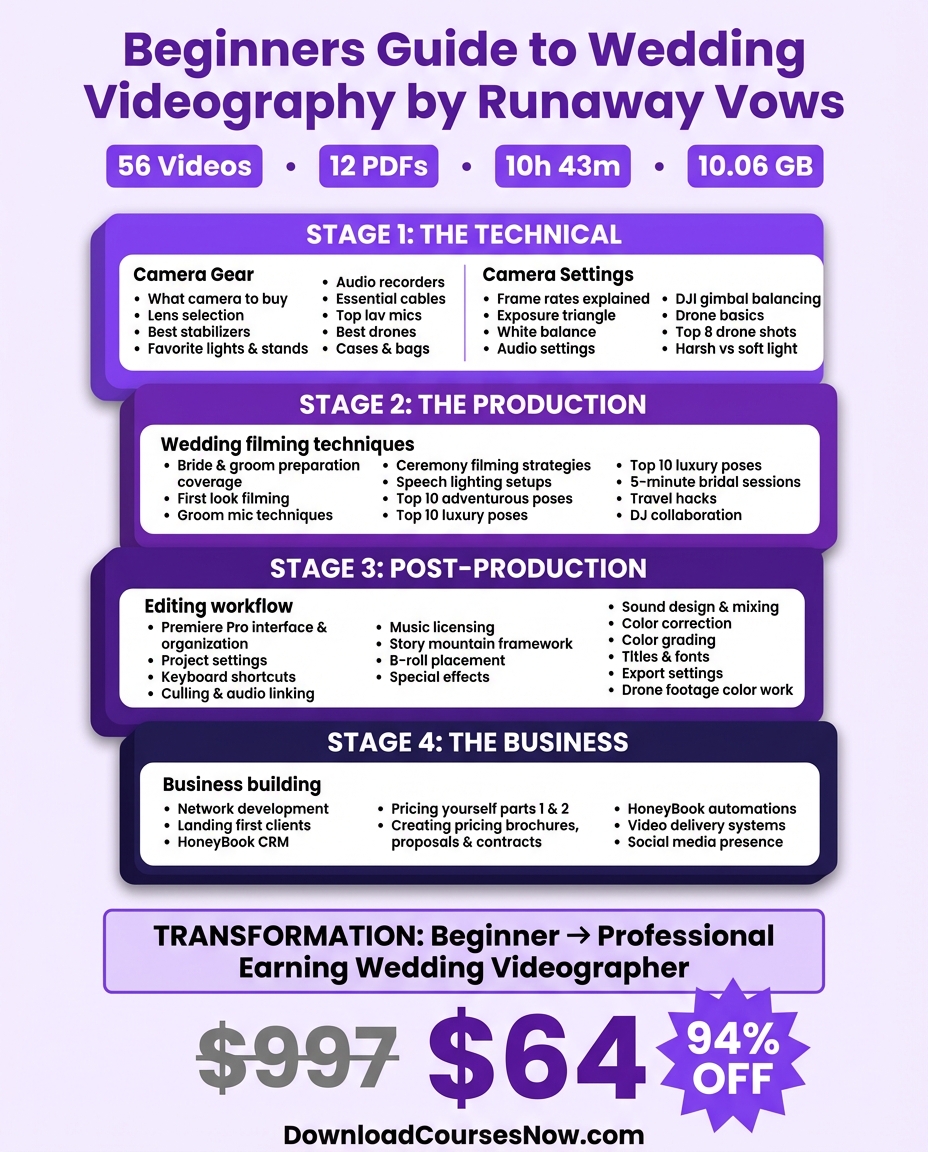
The Beginner's Guide to Wedding Videography is a $997 course by Runaway Vows — Jake Weisler and Nate Teahan — covering 53 lessons and 10.7 hours of instruction on camera operation, audio systems, editing in Premiere Pro, and building a bookable wedding film business. It is worth it if you are starting from zero or stuck under $3,000 per event and need one complete integrated system. Skip it if you edit in DaVinci Resolve or Final Cut Pro, operate outside the US market, or are past the beginner stage in your career.
You are about to spend $997 on Runaway Vows' Beginners Guide to Wedding Videography. Maybe you've watched their films online and thought: I could do that. Maybe you shot a friend's wedding with borrowed gear and realized there's a real business somewhere inside what you just experienced. Maybe you've been freelancing for a year and feel like you're improvising every time the ceremony starts.
This article is for you — right now, at this moment of decision.
Course To Action is the pre-read: the thing you do before you spend $997 on a course, or the thing you do instead. We have the actual course. Not the Instagram reels. Not the YouTube previews. The course. All 53 lessons, 10.7 hours of instruction. And we're going to tell you — plainly — whether the $997 is justified for your specific situation.
At a Glance
| Field | Detail |
|---|---|
| Course | Beginners Guide to Wedding Videography |
| Creator | Runaway Vows (Jake Weisler & Nate Teahan) |
| Price | $997 |
| Content | 53 lessons / 10.7 hours |
| Best For | Aspiring and early-career wedding videographers in the US market who want a complete system from gear to booked calendar |
| Core Topic | End-to-end wedding videography business — camera operation, audio, editing in Premiere Pro, and client acquisition through planner relationships |
| Difficulty | Beginner |
| Skip If | Outside the US market, already shooting professionally, need advanced cinematography or color grading, use Final Cut or DaVinci Resolve |
| Verdict | ★★★★☆ — Buy it if you are starting from zero and need one complete system. The audio instruction and business model alone justify the price for most beginners. |
What This Course Actually Is
Most wedding videography education falls into one of two failure modes. It either teaches you to operate a camera without telling you how to run a business, or it teaches business without giving you enough craft foundation to actually deliver a product you're proud of.
Runaway Vows built the Beginners Guide to Wedding Videography around a different premise: a wedding filmmaker is not a camera operator or a business owner. They are both, at the same time, under real-time pressure, with no second takes.
Jake Weisler and Nate Teahan — named among the Top 18 Wedding Videographers in the United States — spent 7-plus years figuring out that system before packaging it into 53 lessons. What the course delivers is a single operational framework that covers every phase of the job: showing up to a ceremony with properly configured gear, placing cameras with enough redundancy to not miss the moment that matters, capturing audio that holds up in a final film, editing in Premiere Pro with a workflow that scales as you take on more clients, and pricing in a way that creates a sustainable business rather than a series of one-off gigs.
The through-line is that every decision in the course connects to every other decision. The camera placement philosophy makes sense because of how the editing workflow is structured. The pricing model makes sense because of the client relationship strategy. This is not a collection of tips. It is an integrated system.
The Frameworks You Are Buying
Hero Shot First Methodology is Runaway Vows' discipline for guaranteeing coverage of the three non-negotiable wedding moments: the groom's reaction to the bride's entrance, the ring and vow exchange, and the first kiss. The principle: identify the shot that will anchor the final film and guarantee that shot before worrying about anything else. This is not about limiting creativity. It is about eliminating the single worst outcome in wedding videography — missing the unrepeatable moment. Scalable 1–4 Camera Placement is Runaway Vows' system for positioning cameras whether you are a solo operator or running a two-person crew. Each tier is additive: one camera is the anchor (full-ceremony coverage), two adds a dedicated reaction and insert layer, three builds redundancy, four enables a roaming creative unit. The core design principle: no tier requires changing what the previous tier is already doing. Audio as Half the Experience — The core insight here is that most beginner wedding videographers obsess over cameras and treat audio as an afterthought. The course devotes real instruction to microphone placement (Tascam DR-10L, positioned six inches below the chin), adapter setups, backup recording strategies, and the specific cable and adapter bag ($100–200 to build) that separates a professional who loses the vow audio from one who doesn't. Base Package + Add-On Pricing (Ending in 7) is Runaway Vows' pricing structure built around a base package with defined add-on options, with all prices ending in 7. The end-in-7 convention is a specific tactic with a specific reason: it leverages price anchoring psychology in a market where couples are comparing multiple vendors simultaneously. Three Laws of Pricing is Runaway Vows' model for determining where your prices should sit, expressed as: Experience × Audience × Demand. Your price is a function of portfolio strength, market segment, and current demand in your geography — not a number you copy once and forget. Planner Relationships Over Social Media — The key takeaway from the client acquisition framework: wedding planners are a more reliable and higher-quality referral source than social media algorithms. A planner who refers you once and has a great experience will refer you again. The course teaches how to identify and build those relationships.The Quick Wins That Deliver Immediate Results
Three tactical adjustments the course teaches that deliver results on the next shoot, regardless of where you are in the full curriculum:
Turn off auto white balance. The course teaches three fixed white balance values to memorize — 5600K for daylight, 3200K for tungsten, 8000K for shade/cloudy — and to set them manually at every venue change. Auto white balance creates inconsistent color shifts between clips that compound significantly in editing. This is a five-second setting change with real consequences for your edit. Build your cable and adapter bag. A dedicated bag with backup audio cables, adapters, and a redundant recording device runs $100–200 to build. It eliminates the most common cause of lost audio on a wedding day. The course covers exactly what to include. Enable Instagram's highest quality upload setting. If you are using Instagram as a portfolio platform, the default upload settings compress your footage in ways that misrepresent the actual quality of your work. The course covers the specific setting change that preserves the quality of what you've actually shot.This is one of 6 frameworks in the Beginner's Guide to Wedding Videography. The complete breakdown — every framework, every limitation — is available on Course To Action. Start free.
Read the Full Beginners Guide to Wedding Videography Breakdown
The course costs $$997. The complete breakdown is $49/year.
Start free — 10 full summaries, no credit card
What It Does Not Cover
We tell you what the course DOESN'T cover. No other review does this.
The main limitation and what makes this decision clear: the course is Premiere Pro only. All editing instruction is built around Adobe Premiere Pro. If you use Final Cut Pro, DaVinci Resolve, or any other NLE, the editing workflow chapters will not transfer directly to your setup.
The course is built for the US market. The business model instruction — pricing, client acquisition, planner relationships — is designed around the US wedding industry. Pricing norms, planner relationship dynamics, and platform choices vary significantly by market. International students will find the craft instruction fully applicable and the business instruction partially applicable at best. Advanced cinematography is not here. The course teaches coverage and competence, not advanced visual storytelling techniques. Shallow depth of field work, complex lens selection, advanced color grading, drone operation, stylized lighting — these are outside the scope of what the course promises to teach. That is an honest limitation, not a criticism. The course is explicit about being a beginner's system, and it delivers on that promise without pretending to be something it isn't.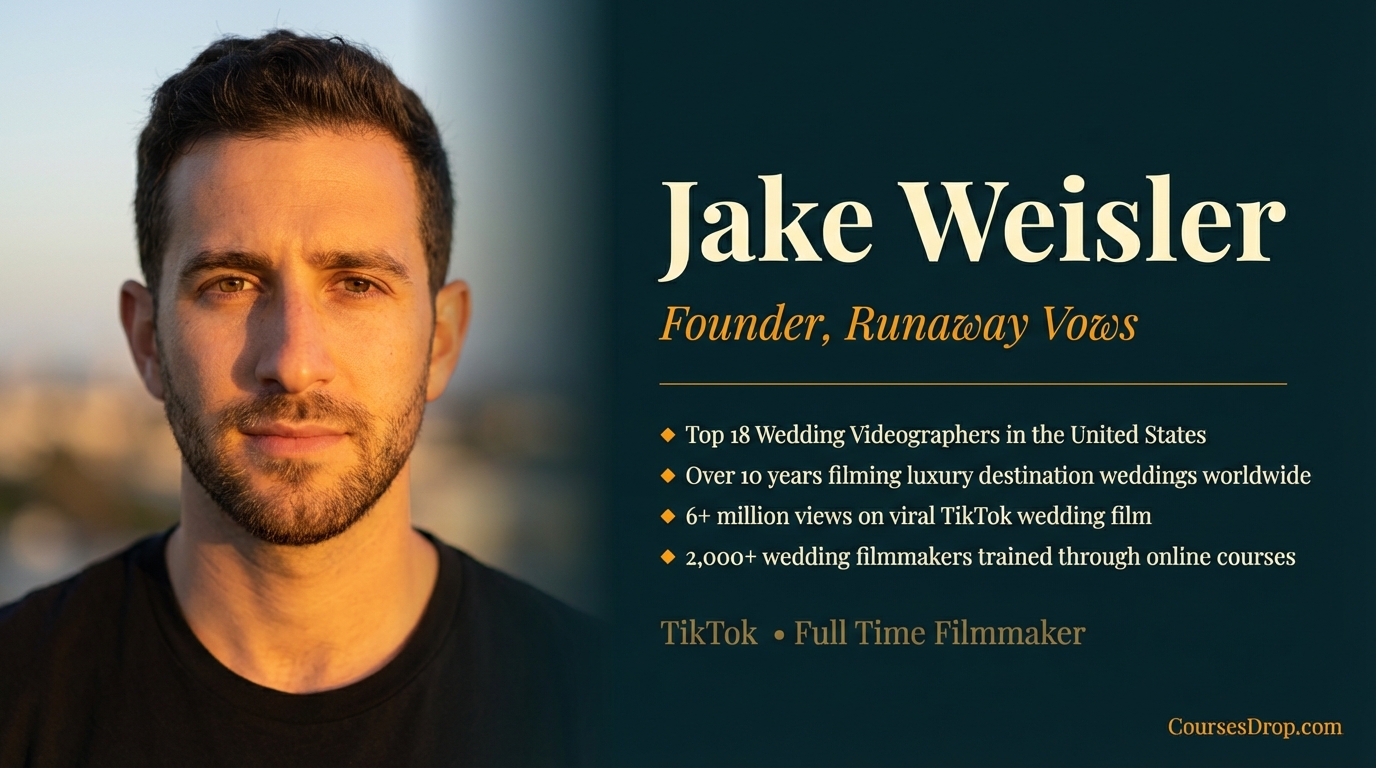
Who Should Buy This
This is best suited for one of these situations:
You have shot one or two weddings — possibly for free, possibly for a friend — and you know there is a real business here but you are currently improvising rather than operating a system. You do not know what to charge. You are not sure how to handle audio redundancy. Your editing process is slow and inconsistent. The Beginners Guide is the structure that converts your raw experience into a repeatable operation.
You are researching wedding videography as a career shift. You have a camera, some experience with video, and a genuine interest in building a creative business. The course is designed to take someone who can operate a camera and turn them into someone who can run a wedding videography business — including the bookings, the client relationships, and the delivery of a finished film.
You are shooting weddings but losing money or breaking even. The pricing module — Base Package plus Add-Ons, ending in 7 — addresses the most common reason competent wedding videographers undercharge. If your current pricing was built by guessing what felt reasonable rather than by modeling a sustainable business, this section of the course alone may justify the $997.
Who Should Skip This
You are an experienced wedding filmmaker. If you have been shooting weddings professionally for more than two to three years with a working system, a booked calendar, and a pricing structure that generates real profit, this course is designed for someone earlier in that journey than you. You will find limited new ground here.
You are outside the United States and your business operates in a different wedding market. The craft instruction transfers. The business instruction is US-market-specific enough that you would be buying a half course.
You edit in anything other than Premiere Pro and do not plan to change. The editing workflow is platform-dependent. If you are committed to another NLE, the editing chapters — which represent a substantial portion of the course — will not be directly applicable to your work.
You want advanced cinematography training. If you are looking for courses on visual storytelling, advanced lighting technique, cinematic color grading, or drone cinematography, this course will not satisfy that interest. It teaches a professional beginner system, not an advanced craft curriculum.
The Verdict
In summary: buy it if you are starting from zero or close to it and need one complete, integrated system rather than a collection of separate resources. The audio instruction alone is worth significant attention — audio failure is the most common and most damaging mistake in beginner wedding videography, and the course treats it with the seriousness it deserves. The planner relationship framework is a more reliable client acquisition path than most social media strategies, and the pricing model gives you a defensible structure you can use immediately.
Skip it if you edit outside Premiere Pro, operate in a non-US market, or are past the beginner stage in your career. The course is honest about what it covers and what it doesn't.
FAQ
Do I need professional camera gear before starting?The course covers gear recommendations as part of the curriculum. You do not need to arrive with a complete professional setup — but you do need a camera capable of manual settings (white balance, in particular). The course teaches you what to add and in what order.
Is the course useful if I already have some wedding shoots under my belt?If you have shot weddings but do not have a systematic approach to camera placement, audio redundancy, editing workflow, or pricing, yes — the course will fill those gaps. If you already have all of those systems working and generating consistent bookings, you will find less new material here.
Is there a community or feedback component?Runaway Vows maintains a community of wedding filmmakers that course students can access. The founders have been active in the community providing feedback.
What is the refund policy?Runaway Vows offers a 30-day full refund guarantee. Verify current terms directly on the sales page before purchasing, as policies can change.
Can I learn wedding videography from this course if I have no video experience at all?The course is designed for beginners, but having some familiarity with how a camera works — even from personal use — will help you move through the early material more efficiently. Complete beginners can work through the course, but expect the gear and camera operation sections to require more time than someone with prior video experience.
Before you spend $997, read the full breakdown on Course To Action. Free account — 10 summaries, no credit card required. The course costs $997. The full breakdown — plus 110+ other courses — costs $49.
Every summary comes with audio, and the 'Apply to My Business' AI tool lets you map any framework directly to your wedding videography situation. One payment, no auto-renewal.
Read the Full Runaway Vows Breakdown on Course To Action Course To Action publishes independent framework-level breakdowns of online courses — the 20% that delivers 80% of the value, so you can make an informed decision before you spend a dollar.Read the Full Breakdown Before You Spend $$997
The course costs $$997. The complete breakdown — every framework, every lesson, every limitation — is $49/year.
Know exactly what you're getting before you commit. Every module summarised, every action step extracted. Read or listen — every summary has audio.
Start free — 10 full summaries, no credit card required