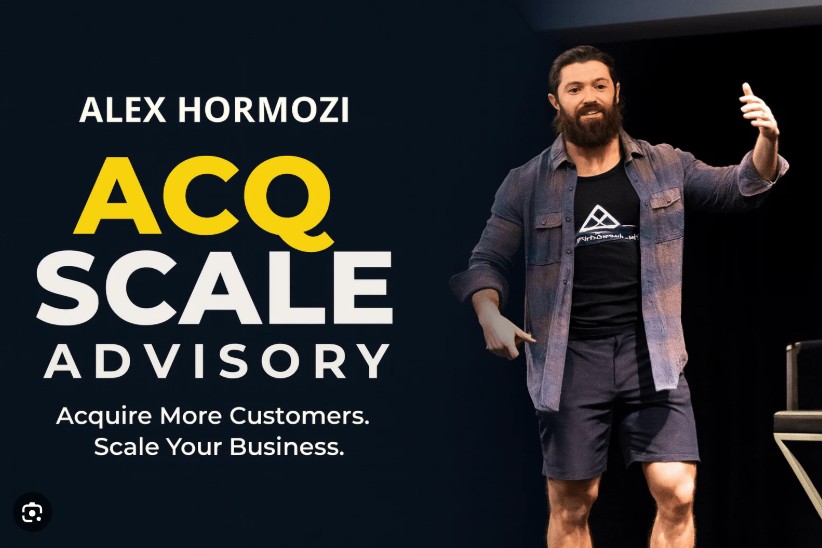
Before You Buy ACQ Scale Advisory by Alex Hormozi: Everything You Need to Know
ACQ Scale Advisory is a high-ticket course by Alex Hormozi — founder of Acquisition.com — that covers 36 lessons across 2 modules on monetization architecture, upsell sequencing, and offer design. The price is high-ticket (exact amount varies through Acquisition.com enrollment). The core promise: structure your offer stack so that the gross profit from your first customer interaction funds the cost of getting that customer in the door, within 30 days. It is worth it for service business operators between $100K and $10M in annual revenue who want to fix fragile acquisition economics. It is not worth it for beginners, lead-generation seekers, or businesses with product quality problems.
The One Question This Course Forces You to Answer
What if your ad budget isn't the problem?
That's the unsettling premise sitting at the center of Alex Hormozi's ACQ Scale Advisory. Most business owners, when customer acquisition gets expensive, reach for the same lever: spend more on ads, test more creatives, hire a better media buyer. Hormozi's counter-argument is blunt — you don't have an ad budget problem. You have a money model problem. Specifically, you haven't structured your business so that the revenue from your first customer interaction funds the cost of getting that customer in the door.
This course is his attempt to hand you the blueprints for doing exactly that. With 36 lessons, a high-ticket price tag, and frameworks pulled from a $250M+ portfolio, it is not a casual buy. Here's everything you need to know before you pull the trigger.
At a Glance
| Creator | Alex Hormozi, Acquisition.com |
| Lessons | 36 |
| Price | High-ticket |
| Best for | $100K–$10M revenue businesses, service owners |
| Core promise | Make customer acquisition self-funding within 30 days |
| Key frameworks | CFA (3 levels), 4-Prong Money Model, Five Upsell Timing Windows, Big Head Long Tail Pricing, Win Your Money Back offer, Menu Upsell |
| What it does NOT cover | Product creation, lead generation, workbooks |
What You'll Learn
The course is built around one central goal: making your customer acquisition cost (CAC) pay for itself before the month is out. Hormozi calls this the "money model" — a deliberate structure of offers, pricing, and upsell sequencing that generates enough gross profit from your existing customers to fund new ones.
The curriculum breaks down across several interlocking frameworks:
CFA — Client-Financed Acquisition (Three Levels) CFA is Alex Hormozi's 3-level framework for mapping the financial relationship between what it costs to acquire a customer and what that customer actually generates in the near term. Level 1 is lifetime gross profit exceeding CAC. Level 2 is 30-day gross profit exceeding CAC — the threshold where you can grow without debt. Level 3 is 30-day gross profit exceeding 2x CAC — the threshold where each customer funds the acquisition of the next. The key takeaway is that identifying which level you are currently at tells you exactly what intervention to make next. The 4-Prong Money Model The 4-Prong Money Model is Hormozi's four-part offer stack framework: Attraction (entry-point offer that acquires customers at break-even or better), Upsell (presented immediately post-purchase to generate first-30-day gross profit), Downsell (fallback that captures partial margin when the upsell is declined), and Continuity (recurring revenue component that builds LTV). Getting all four prongs working in alignment is what makes acquisition self-funding rather than a drain. Five Upsell Timing Windows One of the more immediately actionable parts of the course. Hormozi identifies five specific moments in the customer journey where an upsell is most likely to convert: immediately post-purchase, at the first success moment, at a natural ceiling in the product, at renewal or continuity check-in, and during a referral conversation. The sequencing matters as much as the offer itself. Big Head Long Tail Pricing A pricing strategy for businesses with multiple service tiers or product categories. Rather than flattening your pricing into a single offer, this framework shows how to design a price architecture where high-ticket buyers fund acquisition for the broader customer base. Menu Upsell The Menu Upsell is Hormozi's four-step upsell presentation sequence: Unsell (give the customer permission to decline), Prescribe (frame the offer as a diagnosis of what the customer needs), A or B (present two options rather than a yes/no decision), and Card on File (close on a card rather than full payment to reduce friction). The framing, sequencing, and language of how you present the menu determines whether it converts or creates friction. Win Your Money Back Offer A mechanism for making your first transaction so compelling that the customer feels the upsell is a natural next step rather than an add-on. Hormozi's case study: 100 clients generated 1,800 branded social posts in six weeks through this mechanism.Across these frameworks, the course also touches on billing cycle adjustments, reframing discounts, and processing fee structures — small levers that compound into meaningful revenue differences.
This is one of 6 frameworks in ACQ Scale Advisory. The complete breakdown — every framework, every limitation — is available on Course To Action. Start free.
Is It Worth It?
Let's be direct. This is a high-ticket course, and you should hold it to a high-ticket standard.
The intellectual density is real. Hormozi does not pad. The 36 lessons cover a tight set of interconnected ideas rather than sprawling across surface-level business advice. If you have done the reading — meaning $100M Offers and $100M Leads — you will recognize the vocabulary and build on it quickly. If you haven't, some of the frameworks will require more work to operationalize.
The return on investment depends almost entirely on where your business is right now. If you are running a service business at $300K–$5M in annual revenue and currently running paid acquisition, the math on even partial implementation is compelling. A billing cycle switch alone (moving to 4-week cycles) produces an 8.3% effective revenue increase. Reframing a discount as a "Buy X Get Y Free" structure, adding a 3% processing fee waivable for ACH — these are not revolutionary ideas, but they are specific, implementable, and money-generating.
The frameworks that require deeper work — the full 4-Prong Money Model, the CFA architecture — are where the real value lives, and also where the real effort is required. You need to be willing to reconstruct parts of your offer stack. That is not a weekend project.
The main limitation is this: there are no workbooks, no fill-in-the-blank templates, and no hands-on coaching included at the course level. You are getting the thinking, not the handholding. For self-directed operators who can translate frameworks into their specific business context, that's fine. For people who need guided implementation, it's a gap.
Read the Full This Course Breakdown
The course costs $High-ticket. The complete breakdown is $49/year.
Start free — 10 full summaries, no credit card
Who This Is For
This is best suited for:
- Business owners generating $100K to $10M annually
- Service-based businesses with some existing customer acquisition spend
- Operators who have read $100M Offers or $100M Leads and want the next layer
- Anyone currently losing money on paid ads and assuming the problem is the ads
- Founders who understand unit economics and want to engineer better ones
Who Should Skip It
- Beginners without an existing business or revenue base
- E-commerce operators selling commodity products with thin margins
- Anyone primarily looking for lead generation strategies
- Businesses that need product creation guidance
- People who need structured workbooks or step-by-step implementation support
- Anyone expecting live coaching or community access at this tier
Quick Wins You Can Implement This Week
Even before finishing the course, these moves are ready to test:
- Calculate your 30-day GP vs. CAC ratio. If your gross profit from new customers in the first 30 days doesn't exceed your cost to acquire them, you have a money model problem, not an ad problem.
- Reframe your discount language. Instead of "10% off," structure it as "Buy X, Get Y Free." Same economics. Better perceived value. Higher conversion.
- Switch to 4-week billing cycles. If you offer a monthly subscription or retainer, moving from calendar months to 4-week cycles generates one additional billing cycle per year — an 8.3% revenue increase with zero new customers.
- Add a 3% processing fee, then waive it for ACH payments. This nudges customers toward lower-cost payment processing while creating a perceived benefit for compliance.
FAQ
Is ACQ Scale Advisory worth the high-ticket price? For service business operators between $100K and $10M with existing acquisition spend and thin or fragile unit economics, yes — the frameworks address a structural problem that compounds with scale. For beginners or businesses without product-market fit, no — the program has no foundation to build on at that stage. What does ACQ Scale Advisory actually teach? The program teaches 6 interlocking frameworks for making customer acquisition self-funding: Client-Financed Acquisition (3 levels), the 4-Prong Money Model, the Five Upsell Timing Windows, the Menu Upsell sequence, Big Head Long Tail Pricing, and the Win Your Money Back offer. The through-line is engineering your offer stack so that 30-day gross profit exceeds Customer Acquisition Cost. What does ACQ Scale Advisory NOT cover? The program does not cover lead generation, traffic acquisition, product creation, or guided implementation. There are no workbooks, templates, or live coaching at the course level. Is this the actual $18k advisory, or a course version of it? This is a course distillation of the frameworks and methodology from the ACQ Scale Advisory program. It covers the intellectual content of the system; it is not a live advisory engagement. Do I need to have read $100M Offers first? It's not required, but the course assumes familiarity with offer construction and basic unit economics. Readers of Hormozi's books will get more out of it faster. Does this work for SaaS businesses? The frameworks are most naturally applied to service businesses with discrete offers and upsell opportunities. SaaS operators can extract value, but the examples and language skew toward service models.Verdict
In summary, Alex Hormozi's ACQ Scale Advisory is a high-density, no-filler system for operators who are already in the game and losing ground on acquisition economics. The central insight — that customer acquisition should be self-funding through deliberate offer architecture — is not just motivational framing. It's a real structural problem that the course gives you the tools to solve.
The limitations are honest ones: no workbooks, no product creation, no lead gen, limited support for commodity businesses. But if you're a service operator between $100K and $10M who's been throwing money at ads hoping for a different result, this course reframes the problem in a way that leads somewhere more useful.
The quick wins are real and implementable immediately. The deeper frameworks require work. Both of those things are features, not bugs.
If the frameworks fit your business, it's worth it. If they don't, no amount of Hormozi conviction will change that — and to his credit, he tells you exactly who should skip it.For the full breakdown of all 6 frameworks — including the complete CFA model, every upsell timing window, and the honest limitations — the independent course deconstruction is available at Course To Action.
Not a review score. A complete framework-level analysis so you know exactly what you're buying before you spend on a high-ticket program.
Full breakdown at Course To Action — start free.Course To Action publishes independent framework-level breakdowns of online courses — the 20% that delivers 80% of the value, so you can make an informed decision before you spend a dollar.
Read the Full Breakdown Before You Spend $High-ticket
The course costs $High-ticket. The complete breakdown — every framework, every lesson, every limitation — is $49/year.
Know exactly what you're getting before you commit. Every module summarised, every action step extracted. Read or listen — every summary has audio.
Start free — 10 full summaries, no credit card required